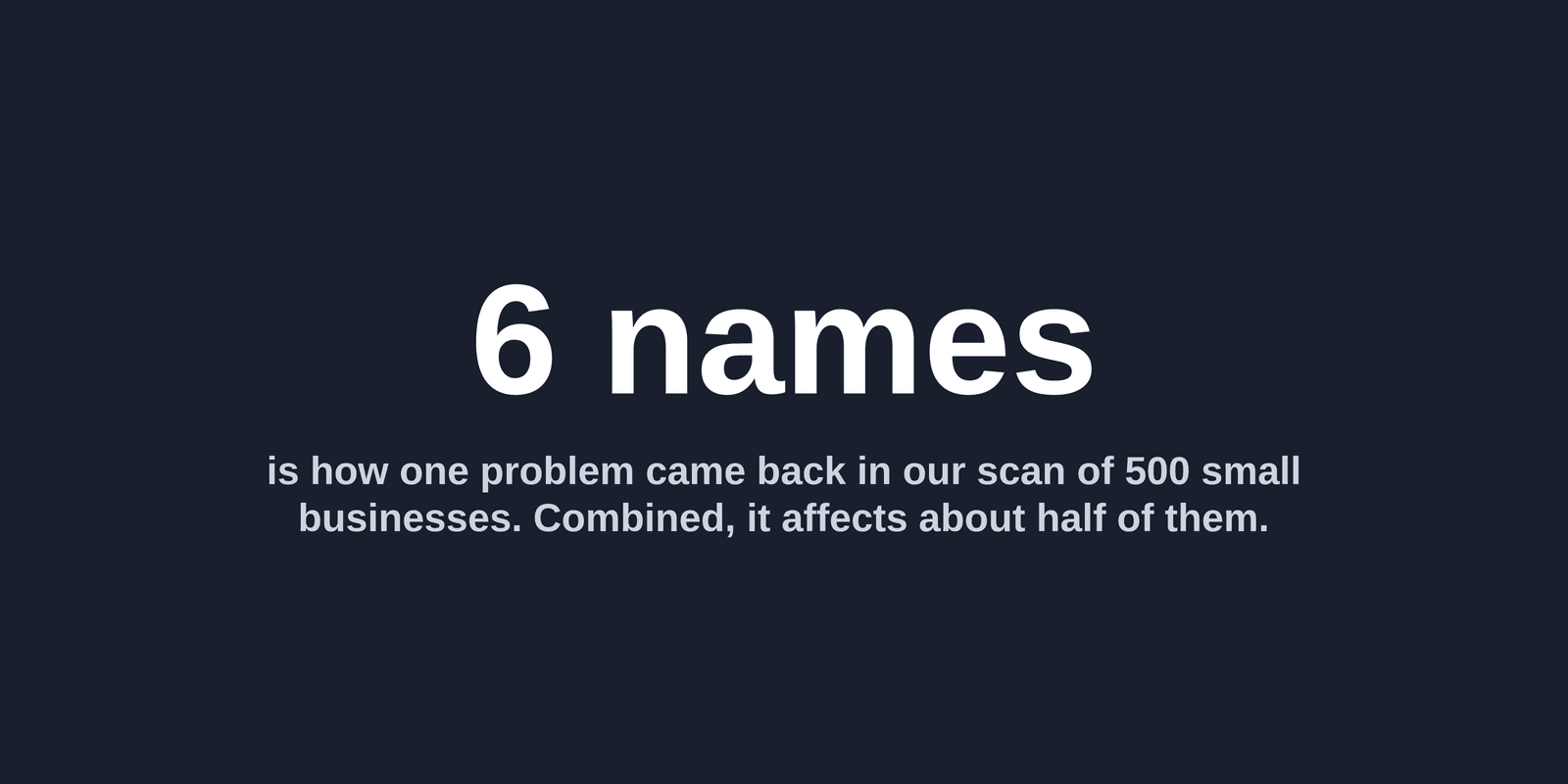
Page speed is the most common problem in the technical part of our scan of 500 small and medium businesses, and it is also the easiest one to miss, because it came back under six separate labels. The largest of the six sits on 20.2 percent of businesses. Combined, some form of it sits on around half the sample.
That is a counting problem rather than a website problem, and it quietly decides which fix you do first. This post covers how one issue ends up with six names, which other issues are split the same way, and how to read your own list so the order comes out right.
One problem, six labels
Our scan files every recommendation under a title, and six of those titles describe the same thing. Slow page load times affecting user experience came back on 101 businesses, or 20.2 percent of the sample. Slow Page Load Speed on 62, or 12.4 percent. Unoptimised images leading to slow page load times on 41. Slow page load times, in lower case, on another 41. Slow Page Load Times, in title case, on 28. Slow page load speed, in lower case, on 17.
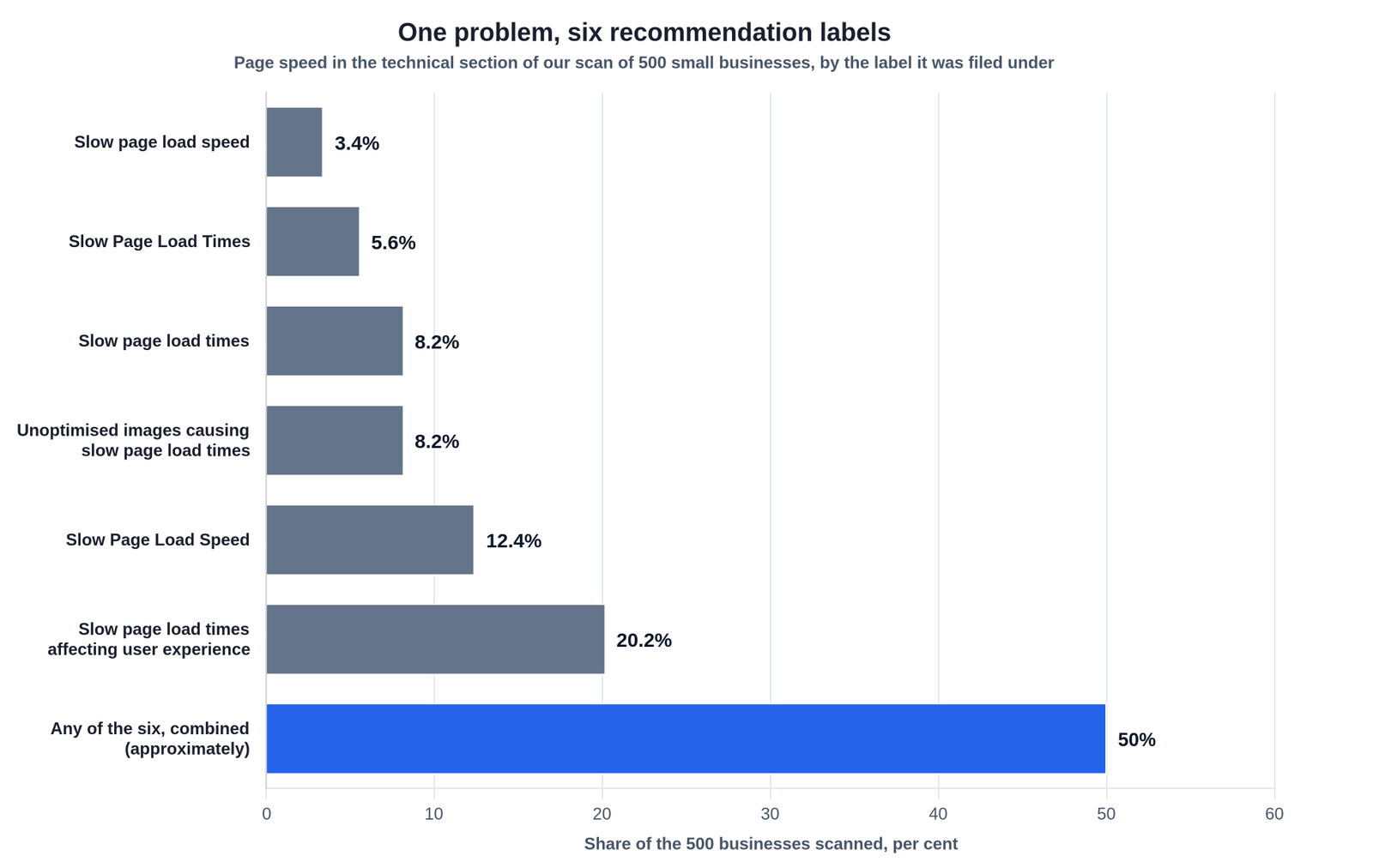
That comes to 290 flagged instances of one underlying problem. A single business can carry more than one of the six labels, so the number of businesses affected is lower than the number of instances, at somewhere above 250, or roughly one in two of everything we scanned. Read the list label by label and page speed looks like the fifth or sixth thing worth worrying about. Group it by cause and it is the largest single entry in the technical section.
It is not only page speed
Three more of the technical titles describe missing or duplicate title tags across a site, and differ only in whether they say multiple pages, some pages or key pages. They came back on 74, 33 and 19 businesses. Two describe a robots.txt file that is missing or set up incorrectly, on 38 and 20 businesses. Two describe pages that do not work properly on a phone, on 34 and 22.
The contrast with the other half of the scan is the tell. Recommendations about the meta layer arrive under one consistent title each, so they get counted once and they look enormous. 94.4 percent of the businesses we scanned have an open item on their meta description, 92.2 percent on their title tag and 66.2 percent on their schema markup, which is the code that tells an assistant what kind of business you are. Those figures are real. So is page speed at around half. One of them just arrives already added up and the other does not.
What this does to the order you work in
The typical business in our scan carried 19.9 open recommendations, 9.2 of them high priority. Nobody clears 19 items in an afternoon, so the order decides what actually gets done, and most people order by whatever looks biggest near the top.
A garden centre in Shrewsbury reading its own list sees six separate speed entries scattered down the page, none of them near the top, and reasonably starts somewhere else. An independent bookshop in Norwich sees the same shape and makes the same call. Neither of them is being careless. The list is presented in a way that hides its own biggest entry.
This is where AI My Site fits. It groups recommendations by what is actually causing them rather than by the title they arrived under, tells you which specific thing is slowing your pages down, and ranks the whole list by impact on AI search visibility, with the recommended value for each item and step-by-step guides for your platform. You work down it in order. The action plan, not just the audit.
What closes the gap, and what it will not close
Two things follow, and the second one matters more than the first. Group before you sort. Six entries collapse into one job, and that job starts with a diagnosis rather than with work: only one of the six labels names a cause, which is unoptimised images, on 41 businesses. The other five tell you pages are slow without saying whether images, scripts, server response time or render-blocking stylesheets are responsible. An hour spent working out which of those it is will save you an afternoon of changing the wrong thing.
Then keep it in proportion. Across the sample, Technical Health averaged 84.1 out of 100 while AI search visibility averaged 73.4, so the technical layer is already the healthiest of the three we score, by roughly ten points. Page speed is worth consolidating because it is the biggest thing in that section, not because it is the biggest thing standing between a physiotherapy clinic in Plymouth and being recommended. 99.8 percent of businesses had at least one unresolved technical issue, and all 500 also had an open item in the AI-brand-specific part of the scan, which is a different layer of work with a lower score behind it.
Common mistakes to avoid
- Sorting the list by how often a title appears. Page speed came back under six titles and not one of them individually looks like the biggest problem on the page. How common a label is tells you nothing about how big the problem is.
- Treating the six speed entries as six separate jobs. The 290 flagged instances across the sample describe one underlying thing. Diagnose the cause once and several list items close together.
- Assuming a title-case label and a lower-case one are different issues. Three of the six differ only in capitalisation and a word or two. They are the same finding written up differently.
- Starting the work before the diagnosis. Only one of the six labels names a cause. Compressing images will not help a site whose real bottleneck is server response time.
- Stopping once the technical section is clean. Technical Health averaged 84.1 across the sample while AI search visibility averaged 73.4. A tidy technical list is not the same thing as being recommended.
How long does this take
Consolidating the list is an hour. Working out which of images, scripts, server response time or stylesheets is actually responsible is another hour on a small site. The work itself varies far more than the diagnosis does: compressing and resizing images across a site is an afternoon, whereas a slow server response can mean a hosting change and a week of scheduling around it. In practice, businesses that work through a prioritised list tend to see movement over a 4 to 12 week window, depending on how many items they carry and how consistently they apply the changes. We cannot give you a date, and anyone who does is guessing. What our data supports is narrower: roughly half the businesses we scanned carry this problem in some form, the typical site carries 9.2 high-priority items in total, and grouping them by cause makes the pile smaller than it first looks.
Frequently asked questions
Why does the same problem have six different names?
Recommendations are written per site rather than picked from a fixed menu, so the same finding arrives with different wording and different capitalisation. Six of the titles in our scan describe page speed. Combined, they cover around half of the 500 businesses.
How common is slow page speed among small businesses?
In our Q2 2026 scan, some form of it affects roughly one in two of the 500 businesses. The largest single label appears on 20.2 percent, which is why the real total is easy to walk past.
Which other issues are split across several labels?
Missing or duplicate title tags across a site, under three labels, on 74, 33 and 19 businesses. A missing or misconfigured robots.txt file, under two labels, on 38 and 20. Pages that do not work properly on a phone, under two labels, on 34 and 22.
Will fixing page speed make AI assistants recommend my business?
We cannot tell you that, and we did not measure it. What we can say is that page speed sits inside Technical Health, which averaged 84.1 across our sample and is already the healthiest of the three layers we score, while AI search visibility averaged 73.4. The largest remaining gap in our data is not in the technical section.
Which AI assistants did you measure?
ChatGPT, Claude and Gemini. Every headline number in this post is the mean of those three. We also scanned Perplexity but excluded it from the headline figures because of its reduced usage relevance, and its numbers sit in the methodology appendix.
See where you sit
Your own list has the same shape as everyone else's. It is longer than it looks in some places and shorter than it looks in others, and the labels will not tell you which is which. We have published the full Q2 2026 State of AI Search benchmark, including the issue prevalence table these six labels come from, the three score layers, and the breakdown by industry, country and platform, so you can see how your own list compares before you start working through it.
Read the full Q2 2026 benchmark to see where you sit.
AI My Site Research · Q2 2026 · n=500. Page speed appears in the technical section of the scan under six separate recommendation titles, on 101, 62, 41, 41, 28 and 17 businesses respectively, which is 290 flagged instances covering roughly half the sample once combined. Technical Health averaged 84.1 and AI search visibility averaged 73.4. We measured AI search visibility, not revenue or conversion. Figures are a Q2 2026 point-in-time snapshot.
See how your own site scores
AI My Site checks all of this automatically and gives you a prioritised, plain-English plan for what to fix first.
Get your scores — £60/month →