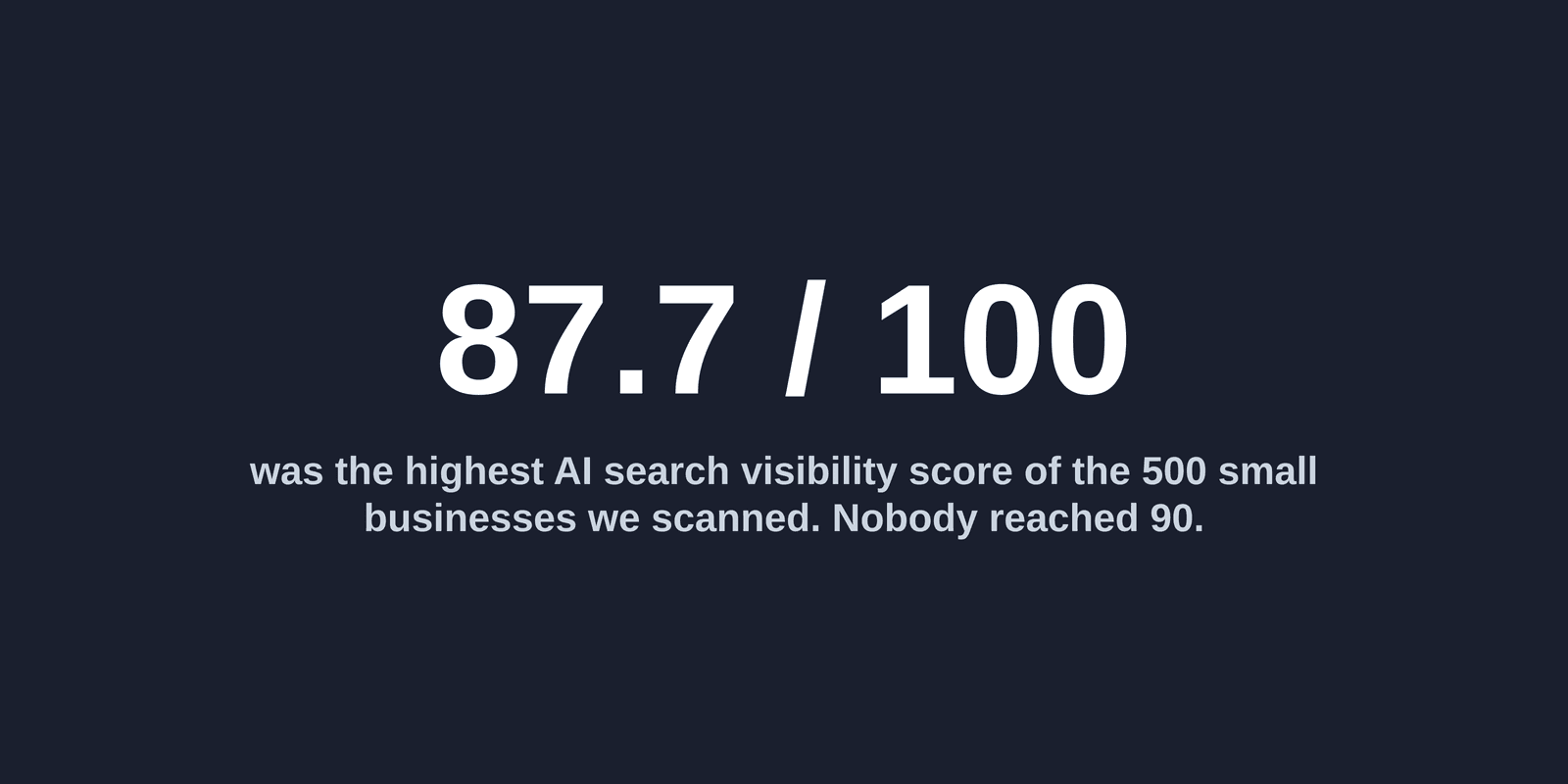
The best AI search visibility score we found across 500 small and medium businesses was 87.7 out of 100, so no business in the sample got past 88 and none reached 90. The sample average was 73.4.
That pairing is the whole argument of our Q2 2026 research in two numbers. This post explains what the floor and the ceiling of the scoreboard tell you, why even the leaders still had work outstanding, and what the distance between typical and best is actually made of.
The scoreboard has a floor and a ceiling
Almost everyone clears the floor. Of the 500 businesses we scanned across ChatGPT, Claude and Gemini, 477 of them, 95.4 percent, scored 60 or above, which is the level at which an assistant knows enough to mention you. Only 23 businesses scored below 60. If you have been worrying that AI assistants have never heard of your business, the odds are strongly against it.
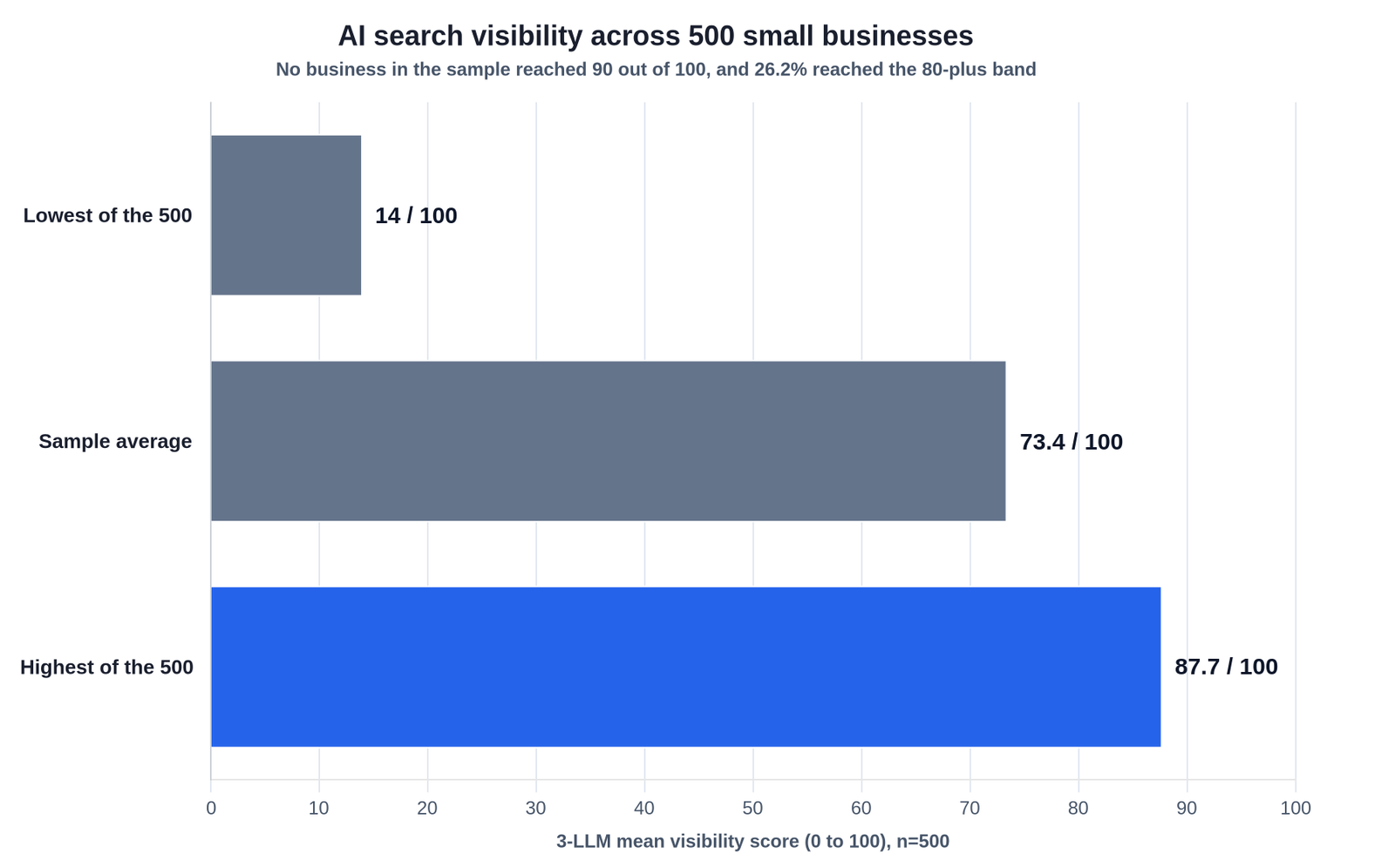
The ceiling is the part people do not expect. The three best-performing businesses in the sample all landed on 87.7 out of 100, and nothing went higher. Meanwhile 26.2 percent of businesses reached the 80-plus band where an assistant recommends you consistently rather than occasionally. So the scoreboard is compressed at both ends: the bottom is nearly empty at 4.6 percent, and the top stops well short of a perfect score.
Why nobody reached 90
Because there was no finished business in the sample. Every one of the 500, including the three that topped the table, had at least one open recommendation in the AI-brand-specific part of our scan. That is 100 percent, with no exceptions by industry, country or platform. On the technical side, 499 of 500 had at least one unresolved issue as well.
Read that as good news rather than bad. It means being recommended by AI assistants is not a state you arrive at and then stop maintaining. A branding studio in Newcastle sitting at 87 is not finished, and a letting agency in Sheffield sitting at 71 is not locked out. Both are on the same scale, working through the same kinds of items, and the leaders are close enough to catch that the distance is a list rather than a rebuild.
What the fourteen points are actually made of
The distance from the sample average to the best score is a little over fourteen points. In practical terms that is a countable pile of work. The typical business in our scan carried 19.9 open recommendations in total, of which 9.2 were high priority. Nine items, not ninety.
Most of them are unglamorous. 94.4 percent of the businesses we scanned had an open recommendation on their meta description, 92.2 percent on their title tag and 66.2 percent on their schema markup, which is the code that tells an assistant what kind of business you are. An employment law solicitor in Derby with a perfectly decent website can be carrying all three at once, because nothing about them is visible to a human reading the page.
Why your existing audit probably looks fine
We scored each business on three separate layers, and they do not move together. Technical Health averaged 84.1 out of 100 across the sample. AI Readiness averaged 74.6. AI search visibility averaged 73.4. The layer that conventional site audits were built to measure is the healthiest one by roughly ten points, which is why a report can come back clean while an assistant still describes your business vaguely or names someone else.
A wedding venue in Harrogate can pass every speed and mobile check going and still lose the recommendation, because the questions an assistant is answering are different: what kind of business is this, who is it for, and is there enough corroborating detail to say so with confidence. Those are not speed problems.
This is where AI My Site fits. It scans how ChatGPT, Claude and Gemini actually describe your business with no prompting, scores all three layers so you can see which one is holding you back, then ranks every open item by its impact on AI visibility with the recommended value for each and step-by-step guides for your platform. You work down the list in order. The action plan, not just the audit.
Common mistakes to avoid
- Assuming the problem is invisibility. 95.4 percent of the businesses we scanned were already visible enough to be mentioned. Starting from the wrong diagnosis sends the work in the wrong direction.
- Treating a good score as a finished job. All 500 businesses had at least one open AI-brand-specific item, including the three at the top of the table. There was no finished site in the sample.
- Judging AI visibility by your technical audit. Technical Health averaged 84.1 while AI search visibility averaged 73.4. A clean technical report does not tell you how an assistant talks about you.
- Reaching for a rebuild. The distance from average to best is about fourteen points and the typical business carries nine high-priority items. That is a list of fixes, not a new website.
- Fixing whatever is easiest first. With 19.9 open items on a typical site, order matters more than effort. Unordered work is the reason good intentions stall in the middle of the pack.
How long does this take
Finding out where you sit is same-day work. Acting on it splits into two halves. The on-site half, the meta layer and schema markup and stating plainly what you do and who for, is an afternoon plus a few hours of follow-up, and it covers most of the nine high-priority items a typical business carries. The half that lives off your own site, reviews and listings and being written about, accrues over weeks because other people control the timing. In practice, businesses that work through a prioritised list tend to see movement over a 4 to 12 week window, depending on how many items they carry and how consistently they apply the changes. Anyone promising a specific score on a specific date is guessing. What our data supports is narrower: the gap between a typical business and the best in the sample is about fourteen points, and it is made of work that has already been identified.
Frequently asked questions
What was the highest AI search visibility score you found?
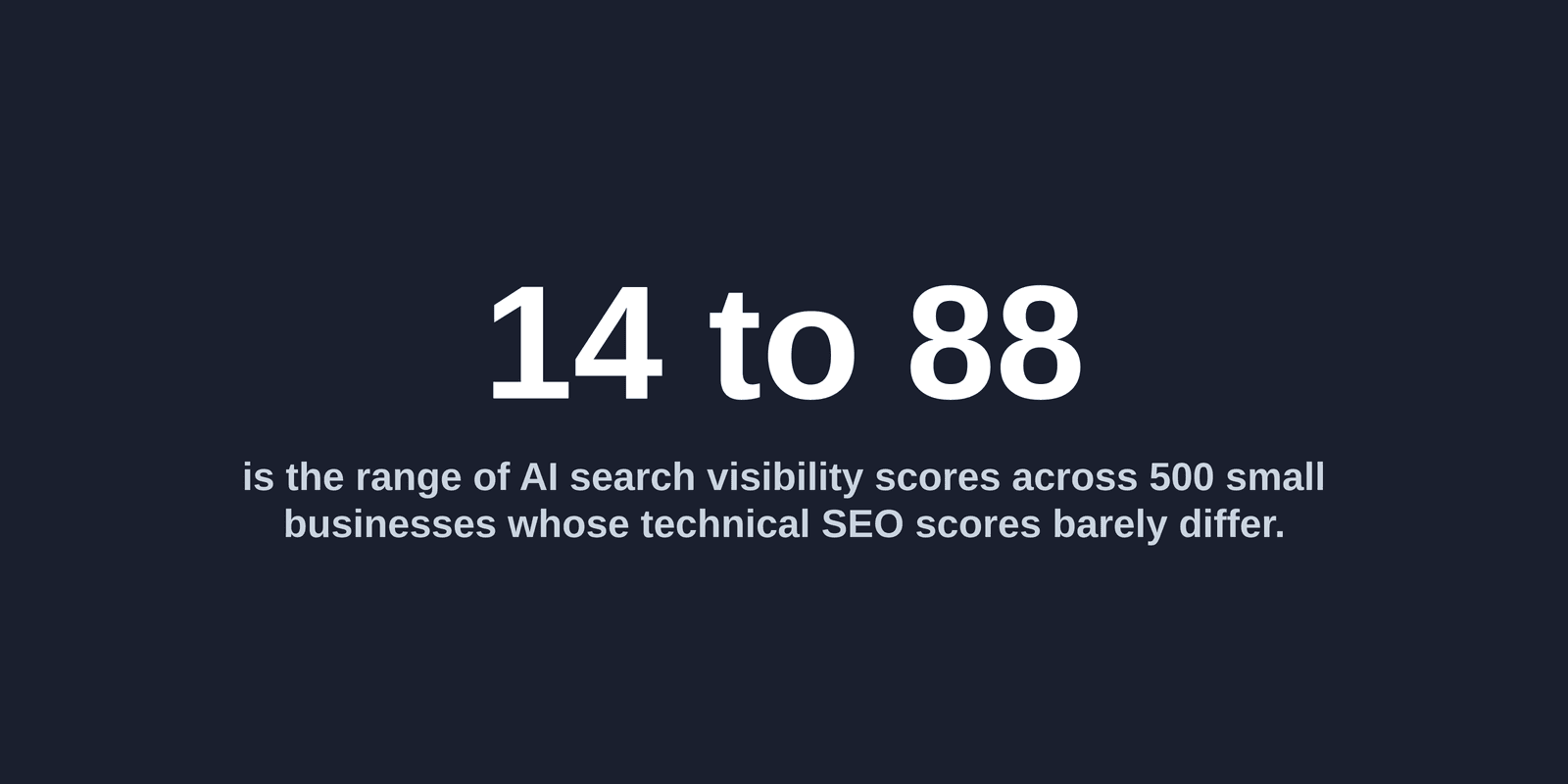
87.7 out of 100, reached by three businesses in the 500-business sample. Nothing scored above 88 and nothing reached 90. The sample average was 73.4 and the lowest score was 14.0.
Is my business likely to be invisible to AI assistants?
Probably not. 477 of the 500 businesses we scanned, 95.4 percent, scored 60 or above, which is enough for an assistant to mention them. Only 4.6 percent fell below that. The common problem is being mentioned without being the recommendation.
How big is the gap between average and best?
A little over fourteen points, from the 73.4 sample average to the 87.7 top score. That gap corresponds to roughly nine high-priority items on a typical site, which is why we describe it as a list rather than a rebuild.
If nobody scored 90, is a high score even worth chasing?
Yes, because the useful comparison is the businesses answering the same customer questions as you, not a perfect score. 26.2 percent of the sample reached the 80-plus band where assistants recommend consistently rather than occasionally, and that band is the realistic target.
Which AI assistants did you measure?
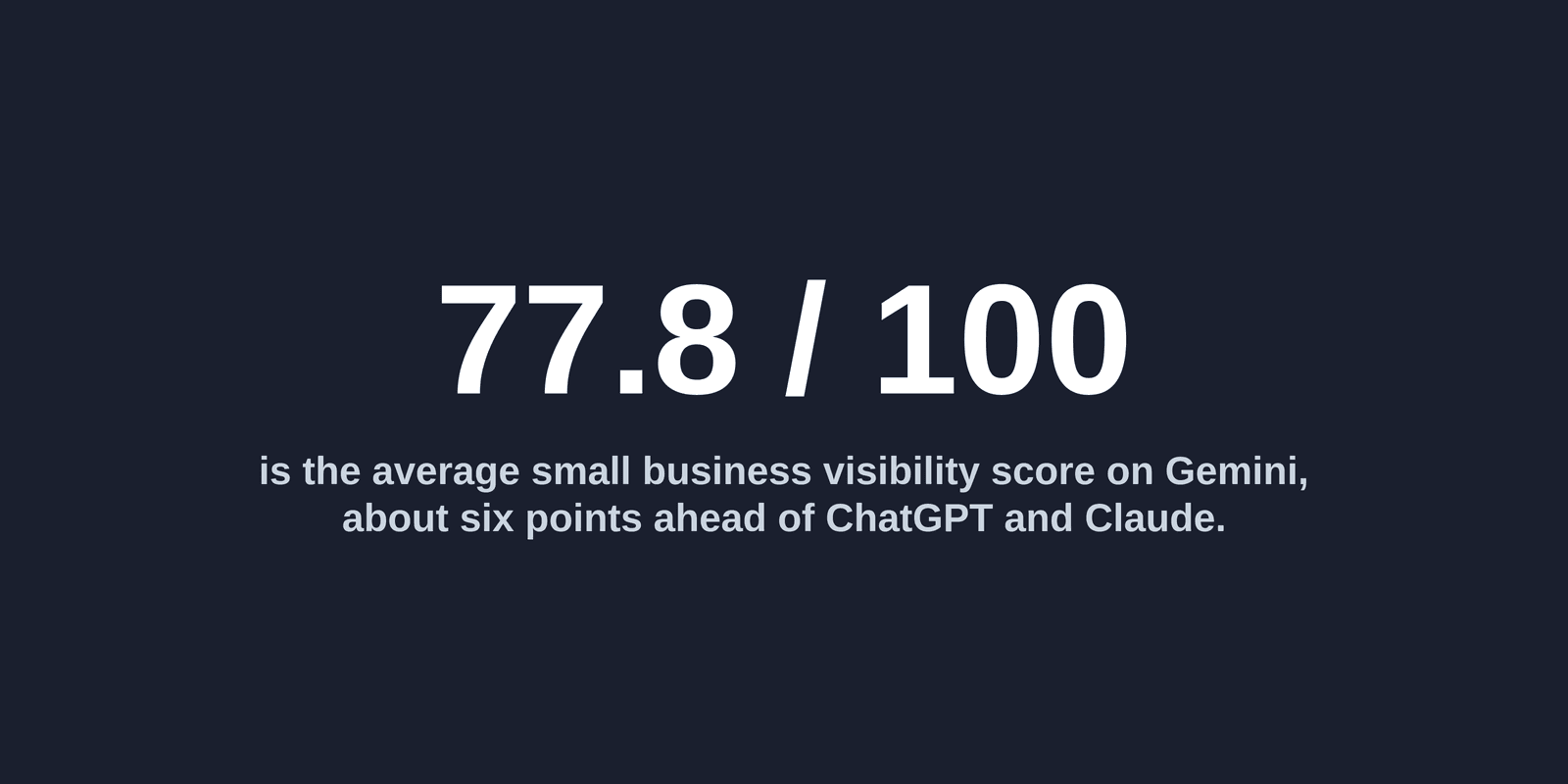
ChatGPT, Claude and Gemini. Every headline number in this post is the mean of those three. We also scanned Perplexity but excluded it from headline figures because of its reduced usage relevance, and its numbers sit in the methodology appendix.
See where you sit
If the whole scale runs from 14 to 87.7 and the average sits at 73.4, the only number that tells you anything useful is your own. We have published the full Q2 2026 State of AI Search benchmark, with the score distribution, the three score layers, the issue prevalence and the breakdown by industry, country and platform, so you can see how you compare before you change anything.
Read the full Q2 2026 benchmark to see where you sit.
AI My Site Research · Q2 2026 · n=500. Highest 3-LLM mean visibility score in the sample 87.7, sample mean 73.4, lowest 14.0. 95.4% of businesses scored 60 or above and 26.2% reached the 80-plus band. 100% had at least one open AI-brand-specific recommendation and 99.8% at least one unresolved technical issue. We measured AI search visibility, not revenue or conversion. Figures are a Q2 2026 point-in-time snapshot.
See how your own site scores
AI My Site checks all of this automatically and gives you a prioritised, plain-English plan for what to fix first.
Get your scores — £60/month →