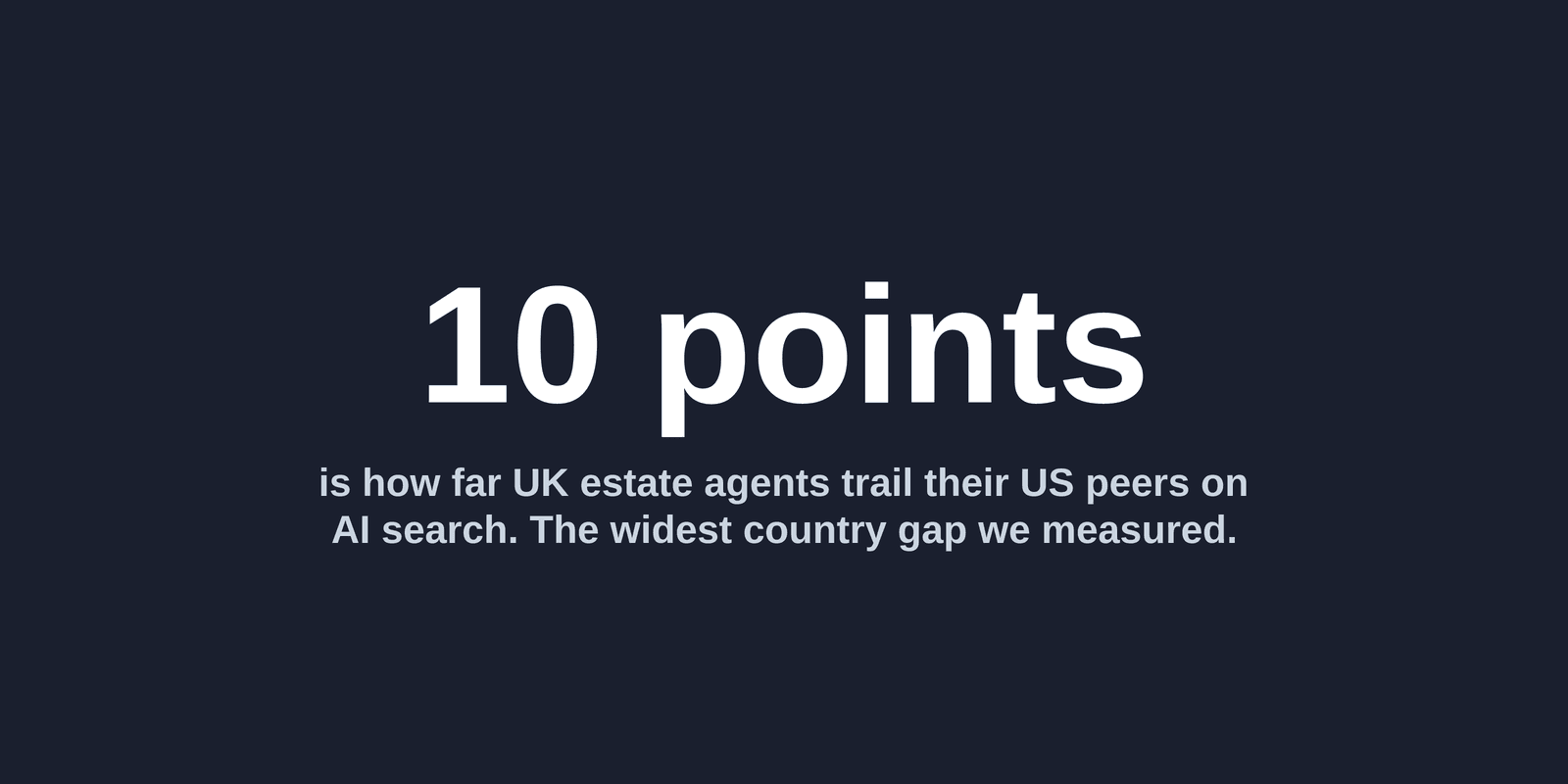
UK estate agents score an average of 67.8 out of 100 on AI search visibility, a full ten points behind their US peers on 78.1, the widest gap between any matched industry and country pair in our 500-business benchmark. It is the largest single catch-up opportunity we found.
This post explains what that ten-point gap is, why it is not a structural disadvantage, and which property-specific fixes close it, based on the Q2 2026 State of AI Search benchmark.
UK estate agents trail their US peers by ten points
When we scored small businesses across ChatGPT, Claude and Gemini, estate agents split sharply by country. UK estate agents averaged 67.8 out of 100 on AI search visibility, the lowest of any well-sampled industry and country cohort in the sample. US estate agents averaged 78.1. The ten-point spread between them is the widest matched-industry country gap in the whole benchmark, larger than any platform or sector difference we measured.
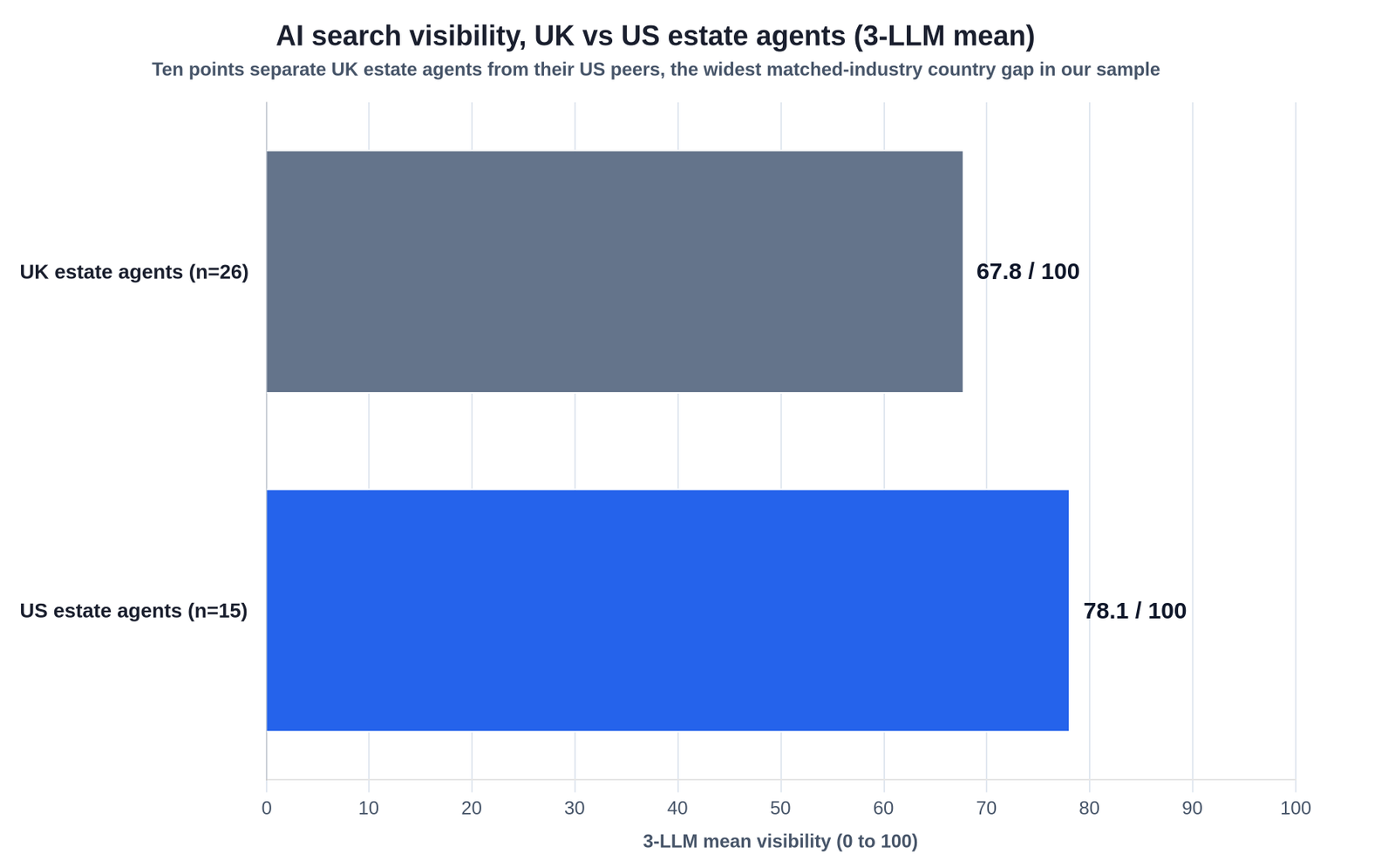
A word on the samples. This is 26 UK estate agents and 15 US ones, so it is a directional finding rather than a national census. The size of the gap is what makes it worth acting on: ten points is wide enough that it points to work not yet done rather than statistical noise.
Why the gap is not a structural disadvantage
The instinct is to assume UK estate agents are somehow harder for AI to see. The data does not support that. US estate agents are not built on better platforms or richer public signals as a group. What separates them is that more of them have done the AI Readiness work: describing each property and branch clearly, marking listings up with structured data, and answering the questions a buyer or seller actually types.
Estate agent content is unusually well suited to this. A listing has a price, a location, a number of bedrooms, a property type and an agent behind it, all facts an AI assistant can lift straight into an answer when they are marked up properly. When they are buried in an image or a slider with no underlying structure, the assistant has nothing clean to quote, so the agency is mentioned vaguely or not at all. The US cohort has simply closed more of that gap.
What closes the trans-Atlantic gap
The fixes are property-specific but not exotic. Start with schema markup for your listings, the structured code that tells an assistant this is a three-bedroom house in a named town at a given price. Add locality content, clear pages for each area you cover rather than one generic patch map, because buyers and sellers search by place. Then build transaction-intent pages that answer the real questions, what a home is worth in a postcode, how long a sale takes, what your fees are.
This is where AI My Site fits. It scans your site, ranks every relevant issue by its impact on AI search visibility, and gives you the top items first with the recommended value for each, plus step-by-step guides for platforms like WordPress and the common property CMS setups. You fix in sequence, no diagnosis and no guesswork. The action plan, not just the audit.
Common mistakes to avoid
- Treating the gap as a UK disadvantage. US estate agents are not structurally ahead. They have done more of the AI Readiness work, which means the ten-point gap is closeable rather than fixed.
- Leaving listings as unstructured images. Price, location, bedrooms and property type belong in schema markup an assistant can read, not trapped inside a photo gallery or a slider.
- Relying on one generic area page. Buyers and sellers search by place. A clear page for each locality you cover gives AI assistants something specific to surface when someone asks about that town.
- Skipping the questions people actually ask. Valuations, timescales and fees are transaction-intent queries. Pages that answer them plainly are the ones an assistant can quote back to a buyer.
How long does this take
The first pass on a typical estate agent site is an afternoon of work rather than a project: the listing schema and the main locality pages, then a few hours over the following weeks to fill in the transaction-intent pages and check them. Anyone promising an instant jump in AI answers is guessing. In practice, businesses that clear a prioritised list tend to see movement over a 4 to 12 week window, depending on how many issues they carry and how consistently they apply the changes. What the data supports is simpler: the gap is about ten points, and it reflects work the leading cohort has already done.
Frequently asked questions
How far behind are UK estate agents on AI search?
In our Q2 2026 benchmark UK estate agents averaged 67.8 out of 100 on AI search visibility against 78.1 for their US peers, a gap of about ten points. It is the widest matched-industry country gap in the sample, drawn from 26 UK and 15 US estate agents.
Why do US estate agents score higher?
Not because they are on better platforms. As a group they have done more of the AI Readiness work, marking up listings with structured data, publishing clear locality pages, and answering common buyer and seller questions in a way AI assistants can quote.
What should a UK estate agent fix first?
Start with schema markup for your listings so price, location and property type are machine-readable, then clear pages for each locality you cover, then transaction-intent pages on valuations, timescales and fees. Those are the property-specific items that lift visibility most.
Is a sample of 26 estate agents reliable?
It is directional rather than a national census, and we flag the sample size honestly. The gap is worth acting on because ten points is wide enough to reflect real work not yet done rather than statistical noise.
See where you sit
If UK estate agents sit ten points behind their US peers, the useful question is where your own agency sits today and which fixes would move it. We have published the full Q2 2026 State of AI Search benchmark, with the score distribution, the issue prevalence and the breakdown by industry, country and platform, so you can see how you compare.
Read the full Q2 2026 benchmark to see where you sit.
AI My Site Research · Q2 2026 · n=500. UK estate agents scored a mean 67.8 (n=26) and US estate agents 78.1 (n=15) on the 3-LLM visibility mean, a gap of 10.3 points. We measured AI search visibility, not revenue or conversion. Figures are a Q2 2026 point-in-time snapshot.
Rather someone did this for you?
With One Site we rebuild your website and run it for you: a review every fortnight, technical fixes done ourselves, and the content changes you approve.
See One Site — £60 a month →