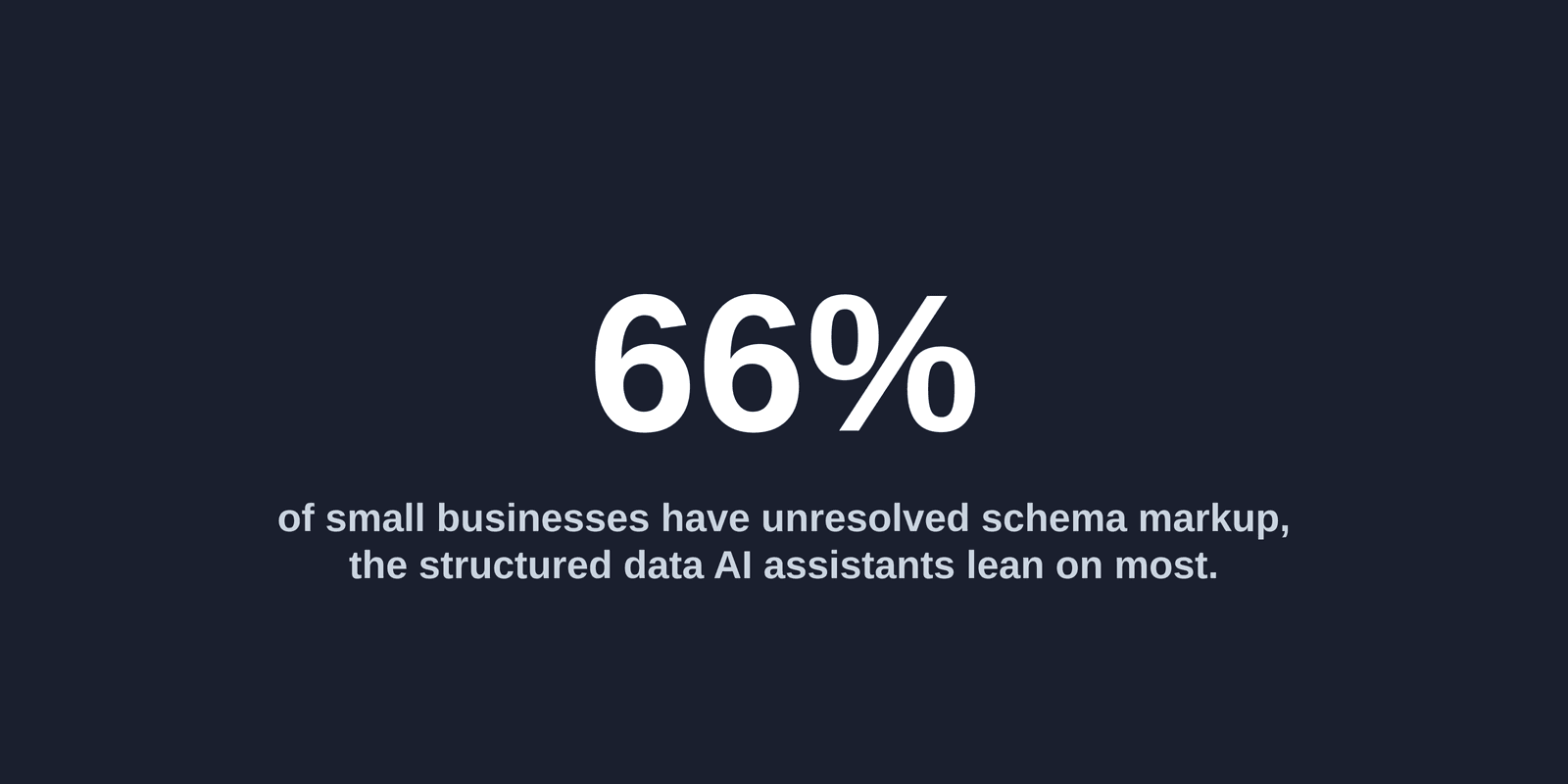
Two in three of the small businesses we scanned, 66% of them, carry an unresolved schema markup issue on their site. Schema is the small block of code that tells an AI assistant exactly what kind of business you are, and it is the highest-impact technical fix most sites are still missing.
This post explains what that 66% actually means, why schema matters more for AI answers than it ever did for classic search, and the focused way to close the gap without touching how your site looks.
Two in three sites are missing it
Across our 500-business benchmark, 331 sites, or 66.2%, had an open recommendation on their schema markup. That puts it just behind the three meta-tag issues we see most often: 94.4% of sites have an unresolved meta description, 92.2% a title-tag issue and 85.2% a keywords-tag issue. Schema sits fourth on the list, which makes it the biggest technical win once the meta tags are sorted.
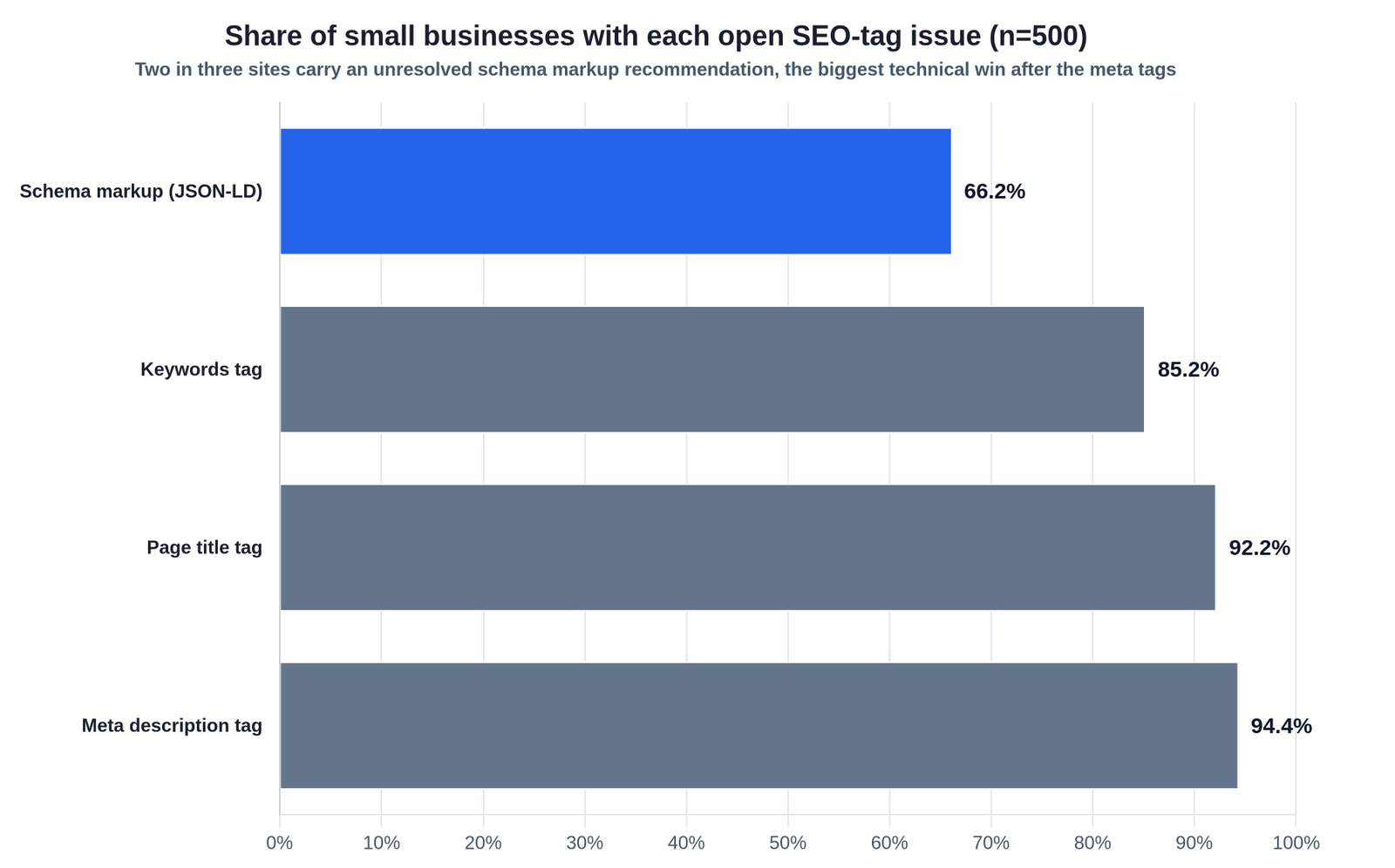
The meta tags are text you write. Schema is structured data you add. It is the one that describes your business in a language machines read directly, so it behaves differently from the rest of the list and rewards a slightly different kind of attention.
Why schema matters more for AI than for Google
Classic search engines treat schema as a hint. It helps them show a richer result, but a page can rank perfectly well without it. AI assistants treat the same code as a foundation. When an assistant answers a category question, such as the best Italian restaurant in a city or a web developer for a small shop, it heavily weights structured data that maps cleanly to a business type. A site with clear schema is easy to place in that answer. A site without it is visible but harder to slot in, so it gets mentioned late or not at all.
This is also why schema shows up strongly in AI Readiness, the layer that measures how parseable your content is, rather than in the SEO basics that most audit tools already cover. The average small business scores well on technical health but lower on AI Readiness, and missing schema is one of the clearest reasons for that gap.
The fix is mostly copy and paste
The good news is that schema is a defined standard, published at Schema.org, with a template for almost every business type. A restaurant has a template, a hotel has one, a professional services firm and an ecommerce store each have their own. The work is not writing code from scratch. It is choosing the right template for what you do and filling in your details, then placing that block on the relevant pages.
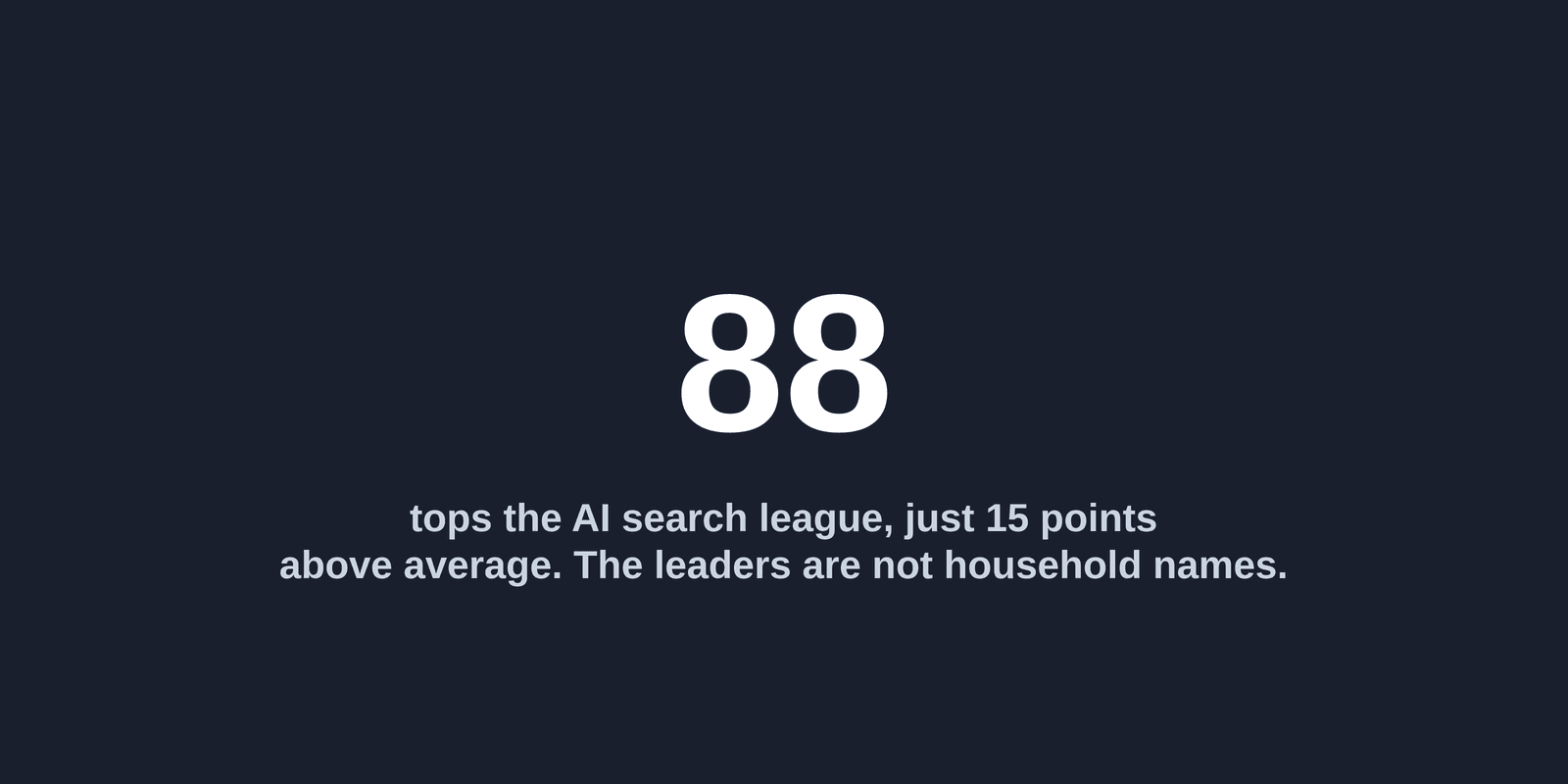
None of that changes how your site looks or reads. It is invisible to a human visitor and decisive for a machine one. The average site in our benchmark carried around nine high-priority issues and sat at 73 on the 3-LLM mean, about 15 points below the top of the table, and schema is usually one of the items on that list. This is where AI My Site fits: it identifies the correct schema block for your business type, gives you the values ready to paste into your CMS, and walks you through it for platforms like WordPress, Shopify and Squarespace. The action plan, not just the audit.
Common mistakes to avoid
- Treating schema as a developer-only job. Most business types have a ready-made template. Choosing the right one and filling it in is a content task, not a rebuild.
- Adding schema and never checking it. A tag with the wrong business type or a broken value can do more harm than none. Validate it after you add it, then move on.
- Assuming your platform did it for you. Two in three sites in our sample had a gap, across every platform. A theme that mentions schema rarely fills in the specifics your business needs.
- Fixing schema before the meta tags. The meta description and title tags are even more widespread and quicker to write. Clear those first, then schema is the next win.
How long does this take
Adding schema to the core pages of a small site is usually an afternoon of work rather than a project, and anyone promising an instant jump in AI answers is guessing. In practice, businesses that clear a prioritised list of fixes tend to see movement over a 4 to 12 week window, depending on how many items they carry and how consistently they apply them. What the data supports is simpler: schema is a defined, template-driven fix, it is missing on two in three sites, and it is well within reach without redesigning anything.
Frequently asked questions
How many small businesses are missing schema markup?
In our Q2 2026 benchmark, 331 of 500 sites, or 66.2%, had an unresolved schema markup recommendation. It is the fourth most common issue overall, just behind the three meta-tag issues.
What is schema markup in plain terms?
It is a small block of structured code, usually JSON-LD, that states what a page is about: the type of business, its name, location, opening hours, products or services. Humans never see it, but search engines and AI assistants read it directly.
Why does schema matter more for AI search than classic search?
Classic search treats schema as a helpful hint. AI assistants use it as a foundation for deciding which businesses to name in a category answer, so a site with clear schema is easier to place and a site without it is easier to skip.
Do I need a developer to add it?
Usually not. Schema is a published standard with a template for almost every business type. The task is picking the right template, filling in your details and pasting the block onto the relevant pages, then checking it works.
See where you sit
If two in three sites are missing the code AI assistants lean on most, the useful question is whether yours is one of them and which fixes would move your score. We have published the full Q2 2026 State of AI Search benchmark, with the issue prevalence, the score distribution and the breakdown by industry, country and platform, so you can see how your business compares.
Read the full Q2 2026 benchmark to see where you sit.
AI My Site Research · Q2 2026 · n=500. 331 sites (66.2%) carried an unresolved schema markup recommendation, behind unresolved meta description (94.4%), title (92.2%) and keywords (85.2%) tags. We measured AI search visibility, not revenue or conversion. Figures are a Q2 2026 point-in-time snapshot.
Rather someone did this for you?
With One Site we rebuild your website and run it for you: a review every fortnight, technical fixes done ourselves, and the content changes you approve.
See One Site — £60 a month →