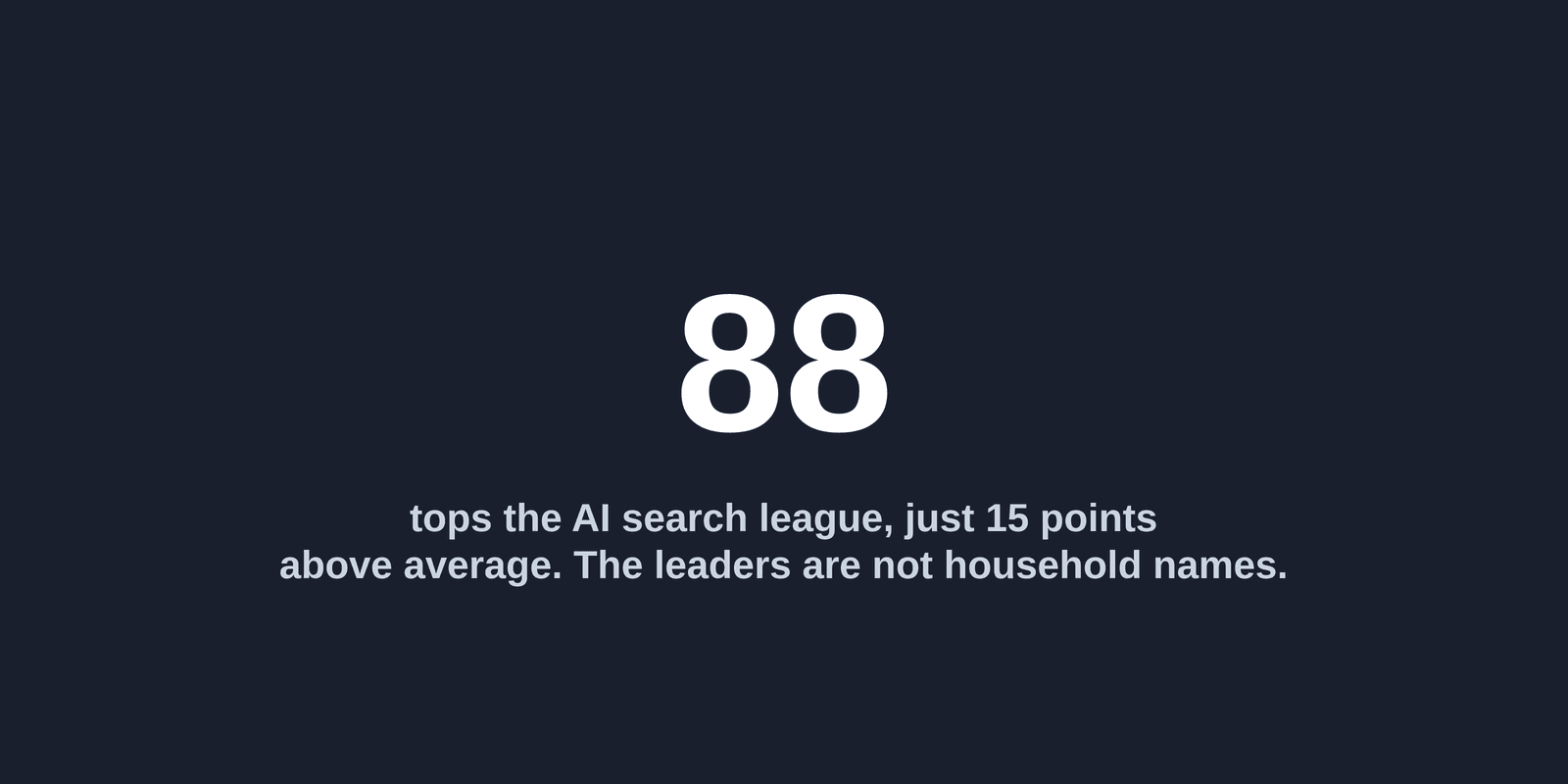
The small businesses at the top of our AI search league score about 88 out of 100, and not one of them is a household name. When we ranked 500 small businesses by how consistently AI assistants find and recommend them, the leaders were regional brands you have probably never heard of, sitting 15 points above the average of 73.
This post covers who actually tops the table, what those businesses have in common, and why the 15-point gap between them and the average site is smaller and more closeable than most owners assume.
Who actually tops the table
The best-performing small business in our sample scored 87.7 out of 100 on the 3-LLM mean, and the top ten all cluster between 86.7 and 87.7. What stands out is the spread. The leaders come from six different industries, from B2B SaaS and hospitality to ecommerce, estate agents and marketing agencies, and from four countries across the UK, US, Ireland and Australia. Among them are two B2B SaaS firms, an estate intelligence platform and a craft beer tours company. No national giants, no eight-figure marketing budgets.
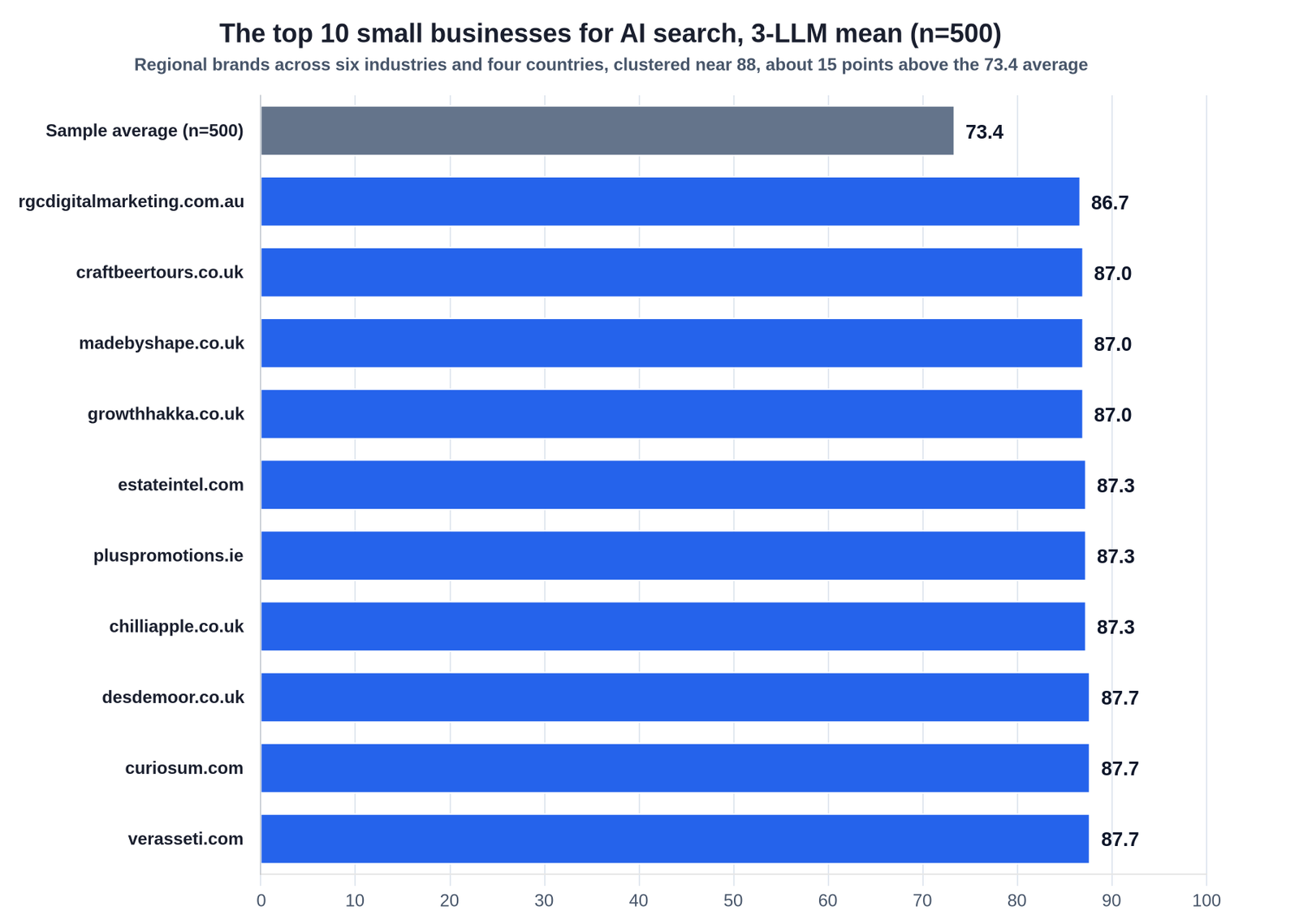
The names are public because the results are reproducible. Anyone can run the same scan on those sites and see the same pattern, which is why the report recognises them by name. The point is not the individual businesses. It is that the top of the league is open to any small business willing to do a specific, ordinary set of things well.
What the leaders have in common
The top performers are not doing anything exotic. They describe themselves clearly. Their meta tags say plainly what they do and who they serve. Their content answers the questions their customers actually ask, in the words those customers would use. Their structured data tells an AI assistant exactly what kind of business they are, so there is no guesswork when it decides whether to name them.
None of that requires a big brand or a big budget. It is the unglamorous work of being easy to understand, done consistently across a site. That is what separates a business scoring near 88 from one sitting at the 73 average, and it is why a craft beer tours company can outrank a far larger competitor that has never structured its content for AI at all.
The gap is 15 points, not 50
The most encouraging finding is the size of the gap. The distance between an average small business on 73 and the top of the table on 88 is 15 points, not 50 and not 30. The distribution is tight, so most sites sit within striking distance of the leaders in their own category. Reaching the AI-ready band of 80 and above is a step, not a leap.
Closing that gap is a focused list of fixes rather than a rebuild. The average site in our benchmark carried around nine high-priority issues, and the top performers are simply the ones who have worked through their own list. This is where AI My Site fits: it benchmarks your scan against the top performers in your specific category, then hands you the prioritised list that closes the gap, with a step-by-step guide for each fix. The action plan, not just the audit.
Common mistakes to avoid
- Assuming you need a household name to compete. The top ten are regional brands across six industries. Size and fame are not what put them there, and their absence will not keep you out.
- Treating the gap as too big to close. It is 15 points from average to the top, not 50. Most sites are within reach of the leaders in their own category.
- Reaching for a rebuild. The leaders did not redesign their sites. They cleared a focused list of specific items, which is a very different amount of work.
- Copying a leader from another industry wholesale. The habits transfer, but the details do not. Benchmark against the top of your own category, not a marketing agency if you run a restaurant.
How long does this take
Because catching the leaders is a list of focused fixes rather than a rebuild, the timeline is measured in weeks, not quarters, and anyone promising an overnight jump is guessing. In practice, businesses that work through a prioritised list tend to see movement over a 4 to 12 week window, depending on how many items they carry and how much they apply. What the data supports is simpler: the gap is about 15 points, the work is specific, and it is closeable without starting your site again from scratch.
Frequently asked questions
What score do the top performers reach?
The best small business in our sample scored 87.7 out of 100 on the 3-LLM mean, and the top ten all sat between 86.7 and 87.7. We round the top of the table to 88 as shorthand for that band.
Are the top performers big, well-known brands?
No. They are regional brands across six industries and four countries, including B2B SaaS firms, an estate intelligence platform and a craft beer tours company. None are national giants, which is the whole point of the finding.
How big is the gap between average and the top?
Fifteen points. The average small business scores 73 and the top of the table sits at 88. The distribution is tight, so most sites are closer to the leaders in their category than they expect.
Do I have to rebuild my site to catch them?
No. The leaders reached the top by clearing a focused list of specific fixes, not by redesigning. The average site carried around nine high-priority issues, and working through them in order is what closes the gap.
See where you sit
If the top of the league is 15 points away and open to any category, the useful question is where your own site sits and which fixes would move it. We have published the full Q2 2026 State of AI Search benchmark, with the named top performers, the score distribution and the breakdown by industry, country and platform, so you can see how your business compares.
Read the full Q2 2026 benchmark to see where you sit.
AI My Site Research · Q2 2026 · n=500. Scores are the 3-LLM mean AI search visibility out of 100; sample mean 73.4, best-performing site 87.7, top ten between 86.7 and 87.7. Top performers are named because their results are public and reproducible. We measured AI search visibility, not revenue or conversion. Figures are a Q2 2026 point-in-time snapshot.
Rather someone did this for you?
With One Site we rebuild your website and run it for you: a review every fortnight, technical fixes done ourselves, and the content changes you approve.
See One Site — £60 a month →