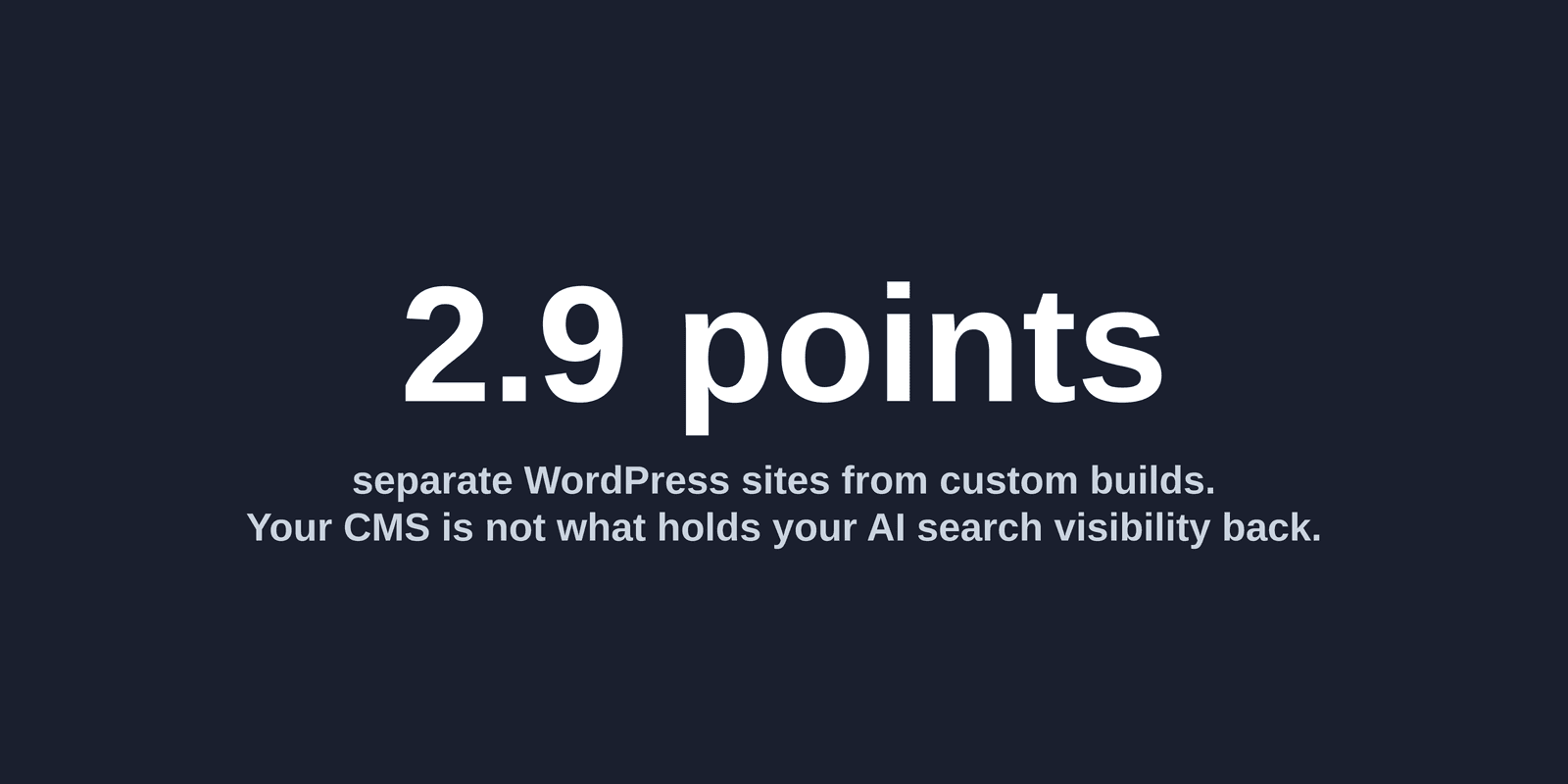
WordPress sites in our benchmark score an average of 72.8 out of 100 for AI search visibility, and sites built on custom or unidentifiable platforms score 75.7. That is a gap of 2.9 points, which is real but small, and it points to something useful: the platform you build on is not what decides whether AI assistants recommend you.
This post covers how the major platforms actually compare across our 500-business benchmark, why the gaps between them are so narrow, and where the visibility difference really comes from once you look past the logo on your CMS.
How the platforms actually compare
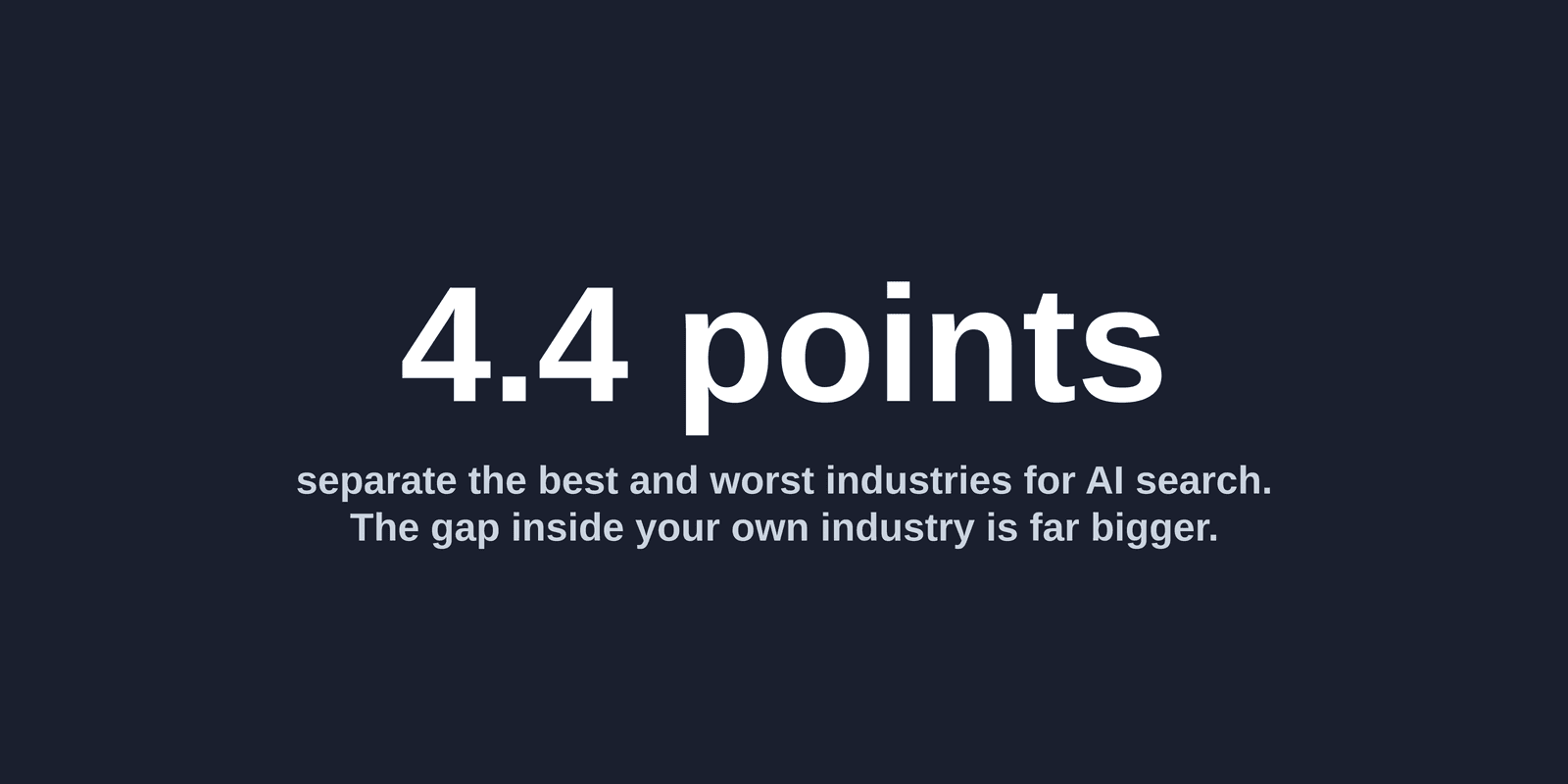
WordPress is the dominant platform in our sample, powering about 63 per cent of the sites we scanned, with an average AI search visibility of 72.8 out of 100 across 315 businesses. Sites whose platform we could not identify, a cohort that skews towards custom and headless builds, averaged 75.7 across 137 businesses. Shopify sat almost exactly level with WordPress on 72.7 across 24 stores, and Squarespace came in lower on 69.8, though that figure rests on just 14 sites and should be read as indicative rather than settled.
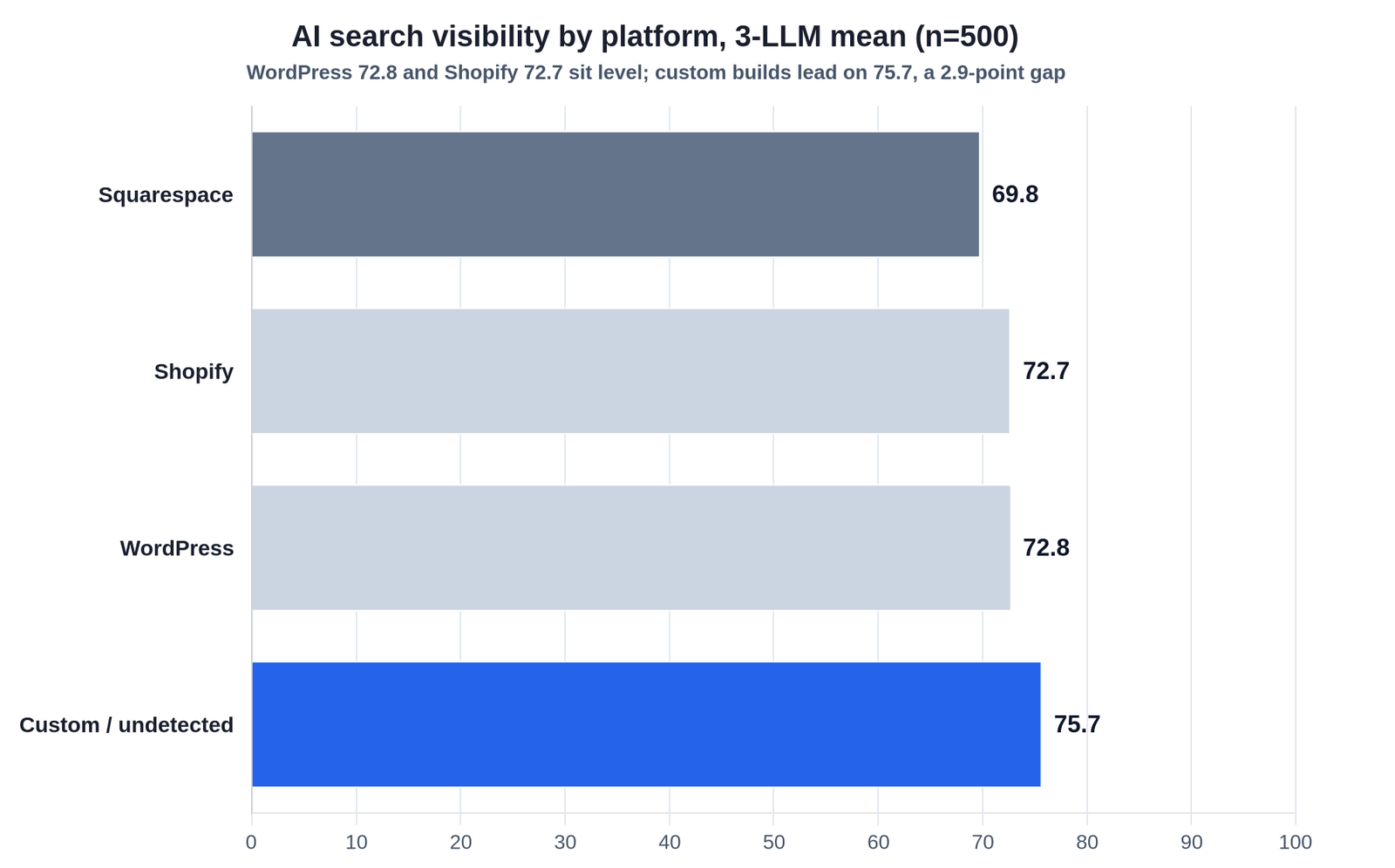
Line the platforms up and the striking thing is how close they are. WordPress and Shopify are separated by a tenth of a point. The whole set, from Squarespace at the bottom to custom builds at the top, spans under six points. No platform in the data is a shortcut to AI search visibility, and none is a sentence to the bottom of the pack.
Why the gap between platforms is so small
The WordPress-to-custom gap of 2.9 points is statistically real. We ran a Welch's t-test on the two cohorts and got a t-statistic of -3.06, which means a difference that size is very unlikely to be chance on these sample sizes. So the effect exists. It is just small, and it needs reading with care.
The custom and unidentifiable cohort is not a single type of site. It mixes bespoke builds, headless setups and heavily customised installs that hide their fingerprints, and those tend to belong to better-resourced businesses that have already put development effort into their sites. So part of that 2.9-point lead is a budget and sophistication signal, not the platform itself. Strip that out and the honest conclusion is that your choice of CMS explains very little of your AI search visibility.
The defaults are the problem, not the platform
If the platform is not the differentiator, what is? The work that sits on top of it. Out of the box, no platform gives you the things AI assistants reward: schema markup that names your business type, category positioning that is clear enough to synthesise into a recommendation, and content that answers the questions your customers actually ask. WordPress does not ship with them, and neither does Shopify or Squarespace. You add them, whichever platform you are on.
That is why the same fixes recur across every platform in our benchmark. The defaults were built for a general-purpose website, not for being parsed and recommended by an AI assistant, so the gap is the same shape wherever you start. This is the layer AI My Site is built to surface: it identifies the specific fixes for your CMS, whether that is WordPress, Shopify or Squarespace, and hands you the prioritised list with a step-by-step guide for each one. The action plan, not just the audit.
Common mistakes to avoid
- Switching platforms to fix AI visibility. A migration is a large project that buys you almost nothing here. WordPress and Shopify score within a tenth of a point of each other, so the move would not touch the real problem.
- Assuming a custom build guarantees a strong score. Custom sites lead on average, but partly because they belong to businesses that have already done the work. The platform is not doing it for them.
- Reading the WordPress figure as WordPress being broken. It is not. The typical WordPress site is simply running on its defaults rather than the optimisations that AI search rewards, and those are addable.
- Treating the Squarespace number as decisive. It rests on 14 sites, below our reporting threshold, so treat it as a hint rather than a verdict on the platform.
How long does this take
Because the fixes are the same regardless of platform, the timeline is too. Adding schema, tightening your positioning and structuring your key pages is a focused piece of work rather than a rebuild, and anyone promising an overnight jump is guessing. In practice, businesses that work through a prioritised list tend to see movement over a 4 to 12 week window, depending on how many gaps they carry and how much they apply. What the data will not support is the idea that changing platforms is the shortcut. The platform accounts for at most a few points, so the timeline is set by the work, not the CMS.
Frequently asked questions
Does WordPress hurt my AI search visibility?
Not in any meaningful way. WordPress sites averaged 72.8 out of 100 in our sample, against 75.7 for custom builds, and the 2.9-point gap is partly explained by those custom sites belonging to better-resourced businesses. WordPress is not holding you back. Its defaults just do not do the AI search work for you.
Should I switch platforms to improve my score?
No. WordPress and Shopify score within a tenth of a point of each other, and the full spread across platforms is under six points. A migration is a large project that would leave the actual gaps, schema, positioning and structured content, exactly where they were.
Which platform scored highest for AI search?
The cohort of custom or unidentifiable sites, on 75.7. That group skews towards bespoke and headless builds run by businesses that have already invested in development, so the number reflects the effort behind those sites as much as the technology under them.
Is Shopify better than WordPress for AI search?
They are effectively tied. Shopify averaged 72.7 and WordPress 72.8, a difference too small to act on. For AI search visibility the platform choice between the two is close to irrelevant, and the work on top of either is what moves the score.
See where you sit
If the platform explains so little, the useful question is where your own site sits and which fixes would move it. We have published the full Q2 2026 State of AI Search benchmark, with the breakdown by platform, industry, country and scan area, so you can see how your setup compares and what the top performers do differently.
Read the full Q2 2026 benchmark to see where you sit.
AI My Site Research · Q2 2026 · n=500. AI search visibility means by platform: custom or unidentifiable 75.7 (n=137), WordPress 72.8 (n=315), Shopify 72.7 (n=24), Squarespace 69.8 (n=14, below reporting threshold). WordPress versus custom gap 2.9 points, Welch's t = -3.06. We measured AI search visibility, not revenue or conversion. Figures are a Q2 2026 point-in-time snapshot.
Rather someone did this for you?
With One Site we rebuild your website and run it for you: a review every fortnight, technical fixes done ourselves, and the content changes you approve.
See One Site — £60 a month →