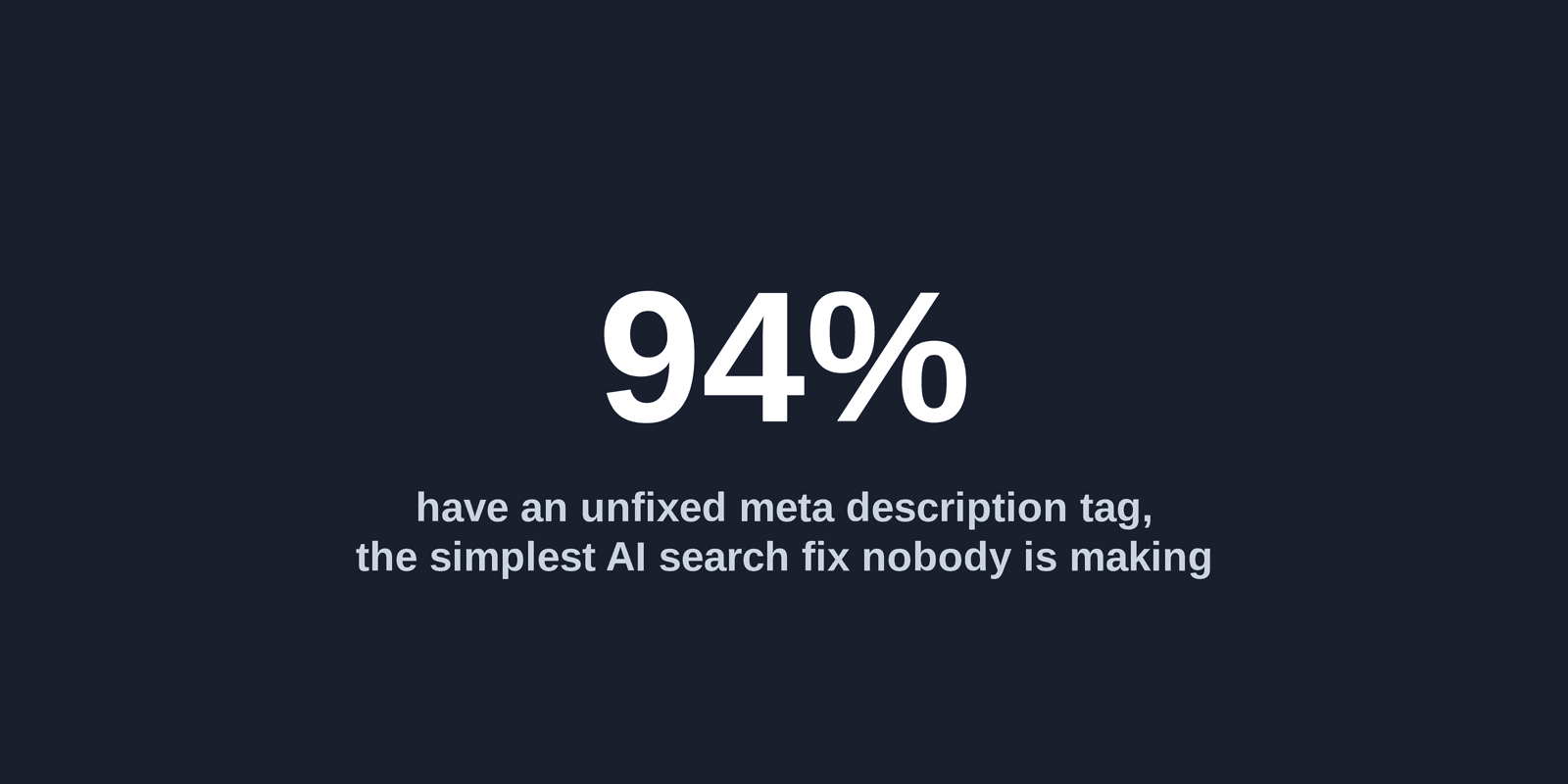
94.4% of the small businesses we scanned, 472 out of 500, have an unresolved meta description tag, the short snippet that tells search engines and AI assistants what a page is about. It is the most widely missed item in our entire benchmark, and one of the quickest to fix.
This post covers why the most basic tags are the most commonly skipped, why knowing a tag is broken is not the same as knowing what to write, and how to close the gap without any specialist work.
The simplest fixes are the most widely missed
Across the 500 small businesses we scanned, the four most common issues were all basic page tags. The meta description tag was unresolved on 94.4% of sites. The page title tag was unresolved on 92.2%. The keywords tag on 85.2%, and schema markup on 66.2%. None of these is specialist work, yet they sit at the very top of the list of things going unaddressed.
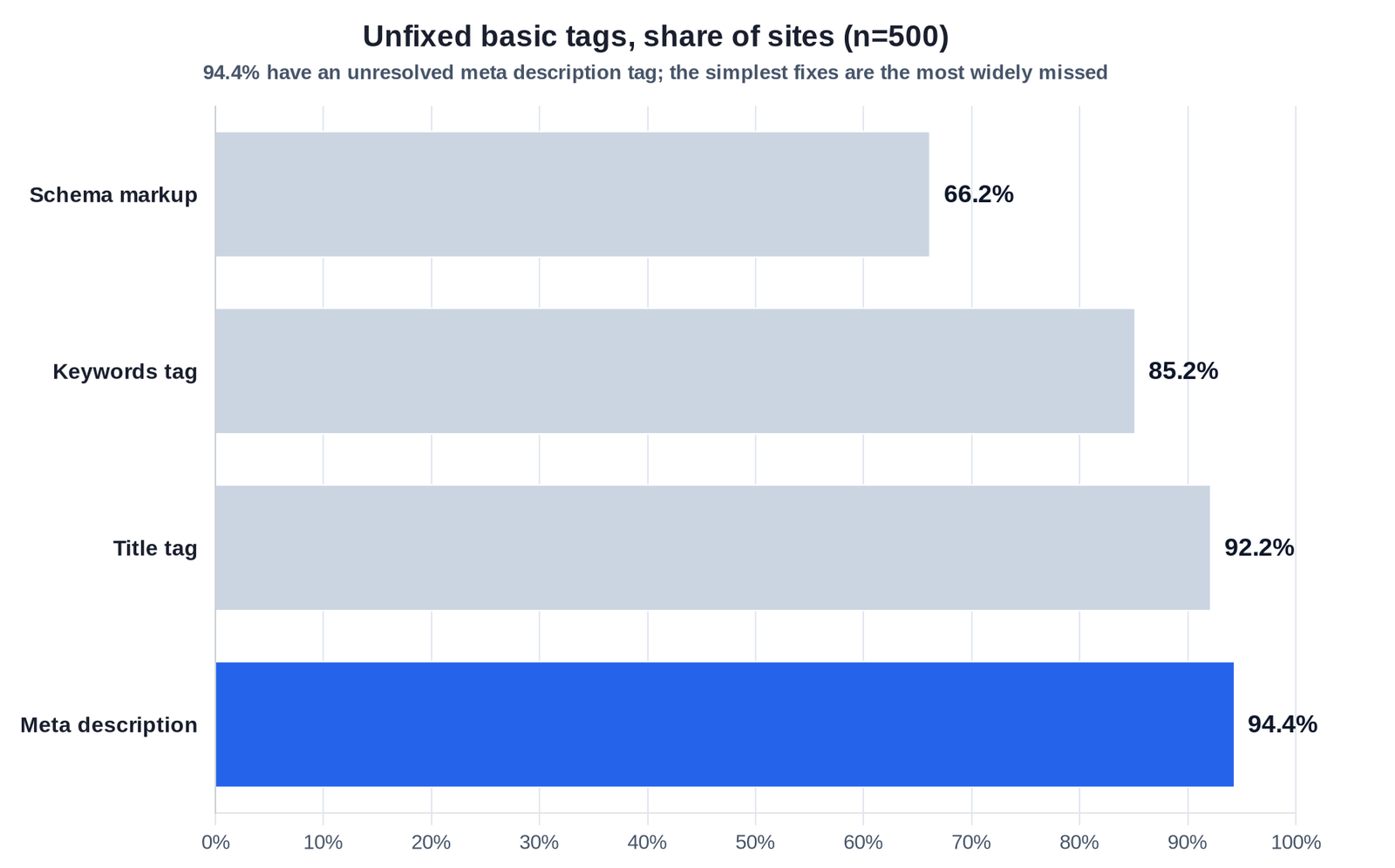
The meta description is the short summary a search engine or AI assistant reads to decide what a page is for. The page title does the same job in fewer words. Both have been web standard for 25 years, and updating them takes minutes per page. They lift AI search visibility because assistants use them as a primary signal for what a business actually does.
Why it happens: the second step is where owners freeze
There are two reasons a fix this simple goes undone. The first is prioritisation. Most audit tools list a broken meta tag alongside fifty other items in an unranked dump, so an owner cannot see which of the fifty to do first, and the work scatters. The second is authoring. Knowing a tag is broken is a different thing from knowing what to replace it with, and most owners stall at that second step.
A plumber knows their meta description is flagged. What they do not have to hand is the one clear sentence that says who they are, what they do and who they serve, written the way a customer would search for it. That blank page, not the technical task, is what keeps the tag unfixed for months.
What closes the gap: a clear line per page
Closing the gap is a writing job, not a rebuild. Each page needs a meta description that names the business, says plainly what it offers and who it is for, and reads like a natural sentence rather than a list of keywords. An accountant might write who they help, the services they run and the town they cover. A boutique hotel might lead with location, room style and what makes a stay different. The title tag carries the same idea in a handful of words.
That is the layer AI My Site is built to surface. It shows you every page with a weak or missing tag, ranked by impact on AI visibility, and drafts the replacement text ready to paste into your content manager. The action plan, not just the audit.
Common mistakes to avoid
- Treating meta tags as an SEO relic. They are still a primary signal an AI assistant reads to understand what a page is about. 94.4% of sites leaving them unfixed is a widely open opportunity, not a solved problem.
- Fixing everything at once. Without a ranked list you spread effort thinly across fifty items. Do the highest-impact tags first, page by page.
- Stuffing the description with keywords. A meta description should read as a clear sentence a customer would recognise, not a comma-separated list. Assistants reward plain, specific answers.
- Writing one tag and copying it everywhere. Each page describes something different. A single description pasted site-wide tells an AI assistant far less than a tailored line per page.
How long does this take
Rewriting the basic tags is a focused job rather than a project, and anyone promising an overnight jump is guessing. In practice, businesses that work a prioritised list tend to see movement over a 4 to 12 week window, depending on how many pages need attention and how much they apply. What the data supports is simpler: these are the most common gaps in the benchmark, they are quick to close, and they do not need a redesign.
Frequently asked questions
What is a meta description, and why does AI care about it?
A meta description is the short summary in a page's code that tells search engines and AI assistants what the page is about. Assistants use it as a primary signal for what a business does, which is why an unfixed one is a missed chance to be understood clearly.
If 94.4% of sites skip it, does it really matter?
The fact that it is common is the point. When most sites in a category leave the same simple signal unclear, the ones that fix it stand out. A tag that takes minutes to write is a low-effort way to be more legible to an AI assistant than most of your peers.
Do I need a developer to change these tags?
Usually not. Most content managers expose the title and description fields in the page settings, so the change is typing a clearer sentence and saving. The harder part is deciding what to write, which is why a ready-to-paste draft helps.
Is schema markup part of the same basic fix?
It is the next step up. Schema markup was unresolved on 66.2% of the sites we scanned. It is slightly more technical than a description tag but still mostly a fill-in-the-template job, and it tells an assistant exactly what kind of business you are.
See where you sit
If the simplest tags are the most widely missed, the useful question is which of your own pages still carry a weak or missing one. We have published the full Q2 2026 State of AI Search benchmark, with the breakdown by scan area, industry, country and platform, so you can see where your category sits.
Read the full Q2 2026 benchmark to see where you sit.
AI My Site Research · Q2 2026 · n=500. Meta description tag unresolved on 472 sites (94.4%), title tag 461 (92.2%), keywords tag 426 (85.2%), schema markup 331 (66.2%). We measured AI search visibility, not revenue or conversion. Figures are a Q2 2026 point-in-time snapshot.
Rather someone did this for you?
With One Site we rebuild your website and run it for you: a review every fortnight, technical fixes done ourselves, and the content changes you approve.
See One Site — £60 a month →