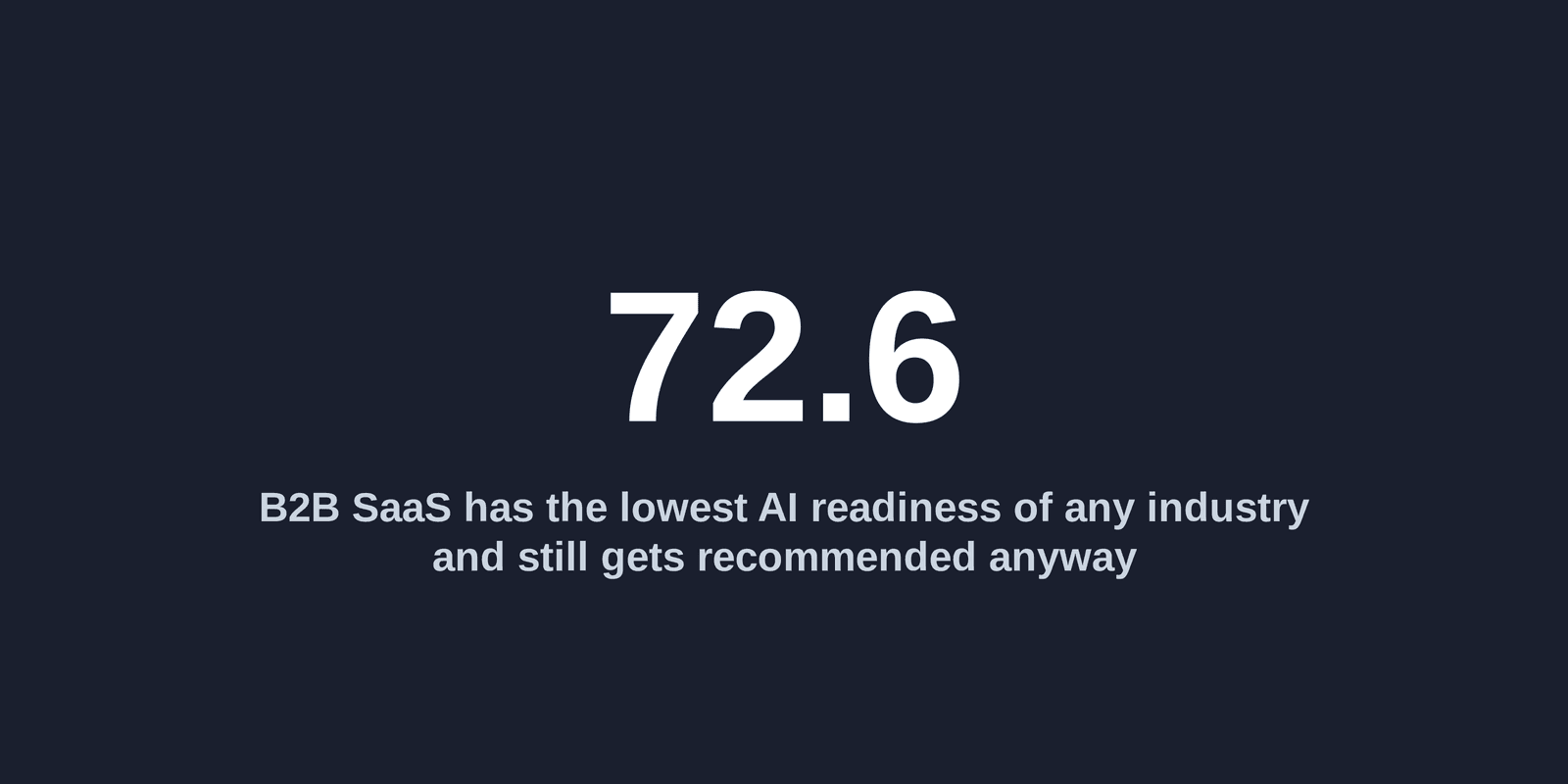
B2B SaaS scores third of six industries on AI search visibility, at 74.2 out of 100, yet it ranks last of the six on AI readiness, at 72.6. It is the least prepared industry we measured, and it is still being recommended.
That is the paradox worth sitting with if you sell software. The buyers researching SaaS are among the most fluent users of AI assistants anywhere, so they ask an assistant to shortlist vendors before they ever reach your site. This post covers why SaaS wins mentions on a weak foundation, why that gap is the opportunity, and what closes it.
Recommended despite the weakest foundation
When we scored 500 small and medium businesses across three AI assistants, we split each score into three layers: technical health, AI readiness, and AI visibility. For B2B SaaS the pattern was unusual. Technical health was healthy, in line with every other industry. AI visibility landed third of six. But AI readiness, the layer that measures how cleanly a site's content can be parsed and reused by an assistant, came last.
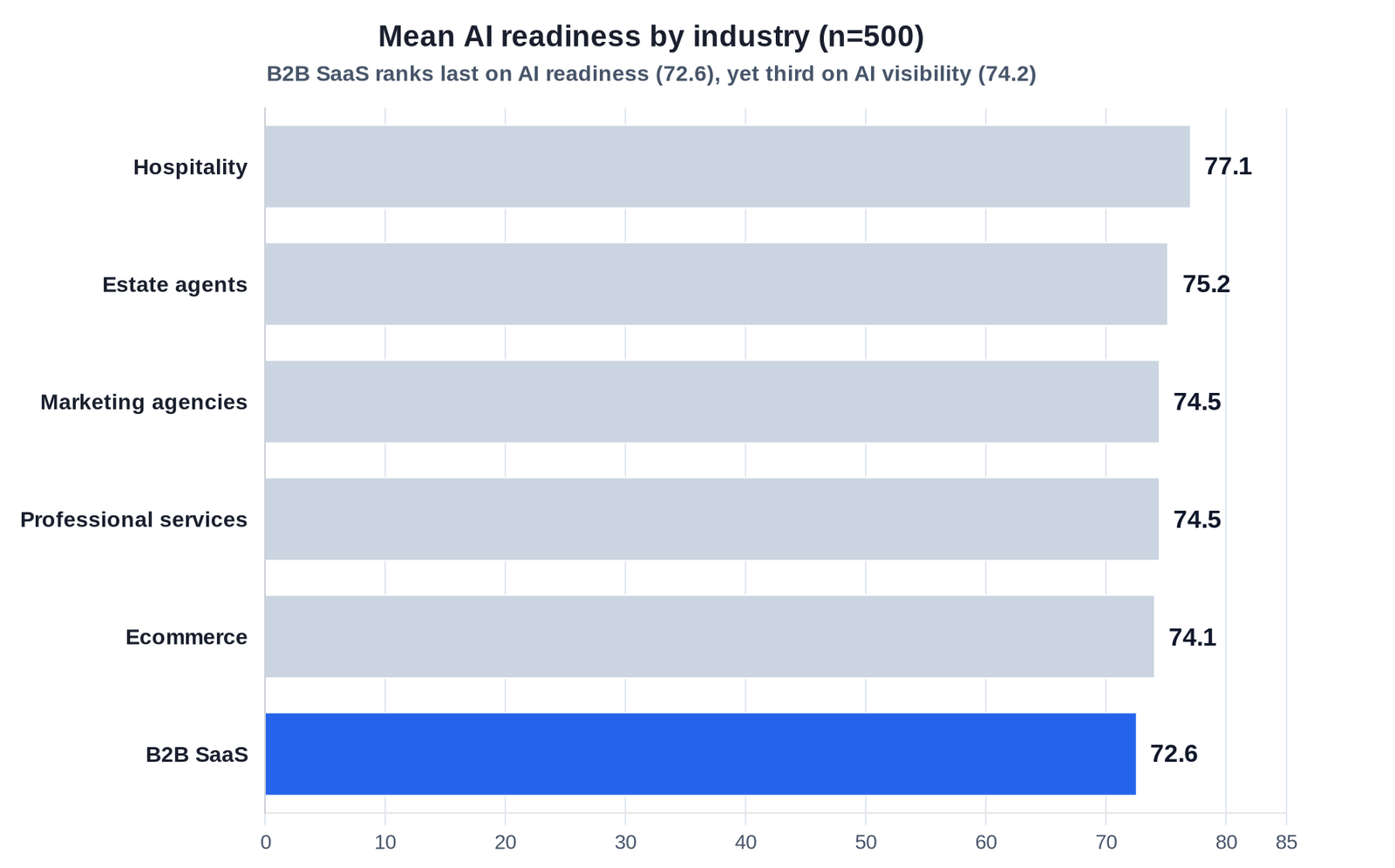
Read that the right way round and it is encouraging. SaaS brands are getting named by AI assistants even though the underlying content is the least AI-ready of any sector. They win mentions on brand weight and category presence, not on how well their pages are structured for a machine to read.
Why SaaS wins mentions anyway
SaaS companies tend to publish a lot: product pages, documentation, comparison content, release notes, help centres. That volume gives an assistant plenty of surface area to pick the brand up, so the business appears when a buyer asks about the category. Presence is not the problem.
The problem is that volume is not the same as structure. An assistant recommends most confidently when a page states plainly what the product is, who it is for, and how it differs, in language a buyer would actually use. A lot of SaaS content is written for existing users or for search engines, not for a model trying to summarise the category in two sentences. The mention happens, but it is generic, and a generic mention is easy to pass over.
Why the gap is the opportunity
Here is why scoring low on AI readiness is good news rather than bad. If you were already getting recommended with a weak foundation, then fixing the foundation does not add a little, it compounds. The mentions you win today are happening in spite of the readiness gap. Close the gap and you are working with the brand weight instead of against it.
The fixes are specific and mostly structural: clear category positioning on the pages that matter, schema markup that tells an assistant exactly what kind of product you sell, and direct structured answers to the comparison questions buyers ask. This is the layer AI My Site is built to surface. It shows you which readiness items are open on your site, ranked by impact, with a guide for each. The action plan, not just the audit.
Common mistakes to avoid
- Reading a good visibility score as done. Being recommended third of six is a strong start, not a finish. The readiness gap underneath it is where the next lift comes from.
- Publishing more instead of publishing clearer. SaaS already produces plenty of content. Another page rarely helps; a clearer statement of what you do and who it is for usually does.
- Writing only for existing users. Documentation and release notes serve current customers. An assistant summarising your category needs plain positioning a newcomer can follow.
- Skipping schema because the site looks fine. A site can look polished to a human and still give an assistant little structured signal about what kind of product it is.
How long does this take
Most readiness items are small once you know which they are, and anyone promising an overnight jump is guessing. In practice, businesses that work a prioritised list tend to see movement over a 4 to 12 week window, depending on how many items they carry and how much they apply. For SaaS specifically the honest expectation is that the foundation work is modest relative to the mentions already being won, which is what makes it worth doing.
Frequently asked questions
What is the difference between AI readiness and AI visibility?
AI readiness measures how cleanly your content can be parsed and reused by an assistant. AI visibility measures whether assistants actually mention and recommend you. B2B SaaS scored 72.6 on readiness and 74.2 on visibility, so it is being recommended more than its foundation would suggest.
Why does B2B SaaS score lowest on AI readiness?
Our reading is that SaaS content is often written for existing users or classic search rather than for a model summarising a category. Volume is high, but plain positioning and structured answers are thinner. That is analysis of the pattern, not a separately measured cause.
Is a sample of 72 SaaS businesses enough to trust?
B2B SaaS was one of six industries with a sample above our headline threshold, at 72 businesses. That is enough to report the finding with confidence while still treating it as a Q2 2026 snapshot rather than a fixed ranking.
If we are already recommended, why do the readiness work?
Because the mentions you win now are happening despite the gap, not because of it. Closing the readiness gap makes those mentions clearer and more frequent, so the effort compounds rather than starting from zero.
See where you sit
If B2B SaaS is being recommended on the weakest foundation of any industry, the useful question is where your own site sits on readiness and visibility. We have published the full Q2 2026 State of AI Search benchmark, with the breakdown by industry, country and platform, so you can see how your category compares.
Read the full Q2 2026 benchmark to see where you sit.
AI My Site Research · Q2 2026 · n=500 (B2B SaaS n=72). We measured AI search visibility, not revenue or conversion. AI readiness measures how parseable a site's content is for AI assistants. Figures are a Q2 2026 point-in-time snapshot.
Rather someone did this for you?
With One Site we rebuild your website and run it for you: a review every fortnight, technical fixes done ourselves, and the content changes you approve.
See One Site — £60 a month →