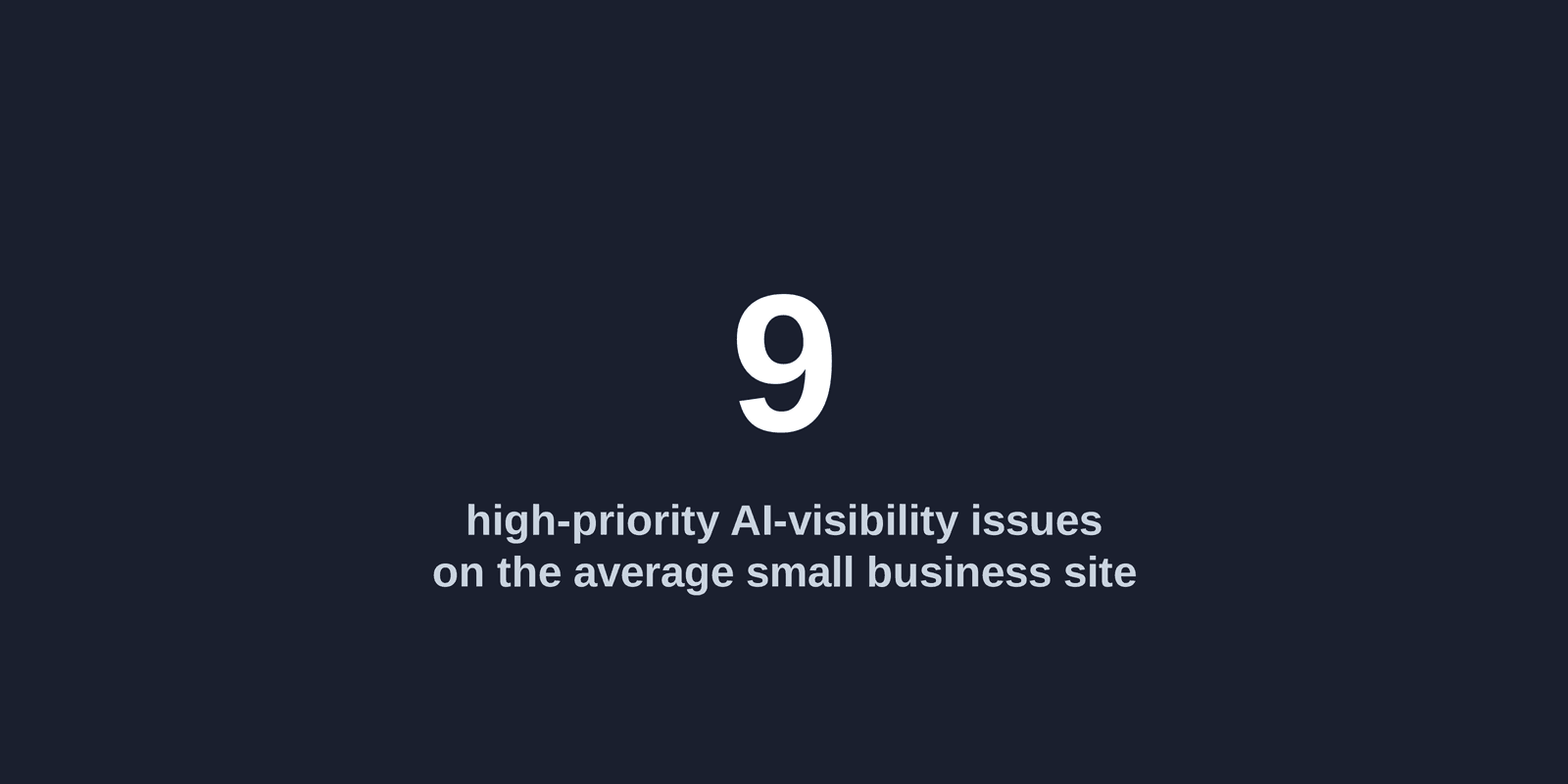
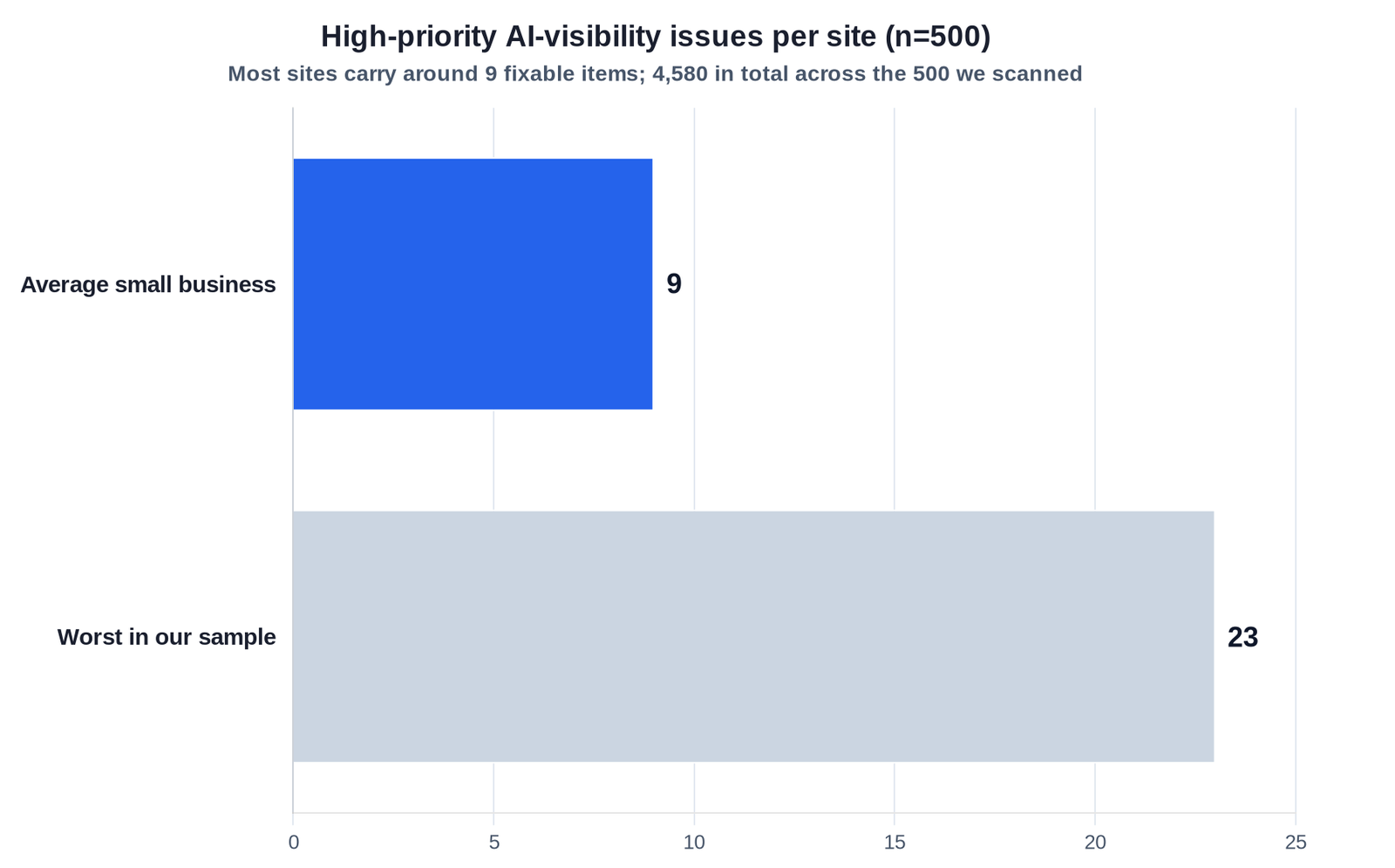
The average small business in our benchmark had nine high-priority issues holding back how AI assistants find and recommend it. Not one big problem, nine small ones. Across the 500 businesses we scanned, that adds up to 4,580 fixable items going unaddressed.
None of them is catastrophic on its own. Together they keep the typical small business in the middle of the pack: visible to AI, just not the one it recommends. This post covers why it is nine small things rather than one big one, the losses you never see, and why the real problem is knowing which to fix first.
Why it is nine small things, not one big thing
There is rarely a single broken thing holding a small business back in AI search. There is a scattering of small ones: a vague service description, a missing trust signal, an out-of-date detail, a thin answer to a common question. In our 500-business benchmark the average site carried nine of these high-priority items, with a median of nine and a spread from zero to twenty-three.
Each one is minor in isolation, which is exactly why they survive. No single item is alarming enough to act on, so the list quietly grows. But an AI assistant weighs all of them together when it decides whether to name your business, so the small things compound into a real gap.
The losses you never see
The trouble with these issues is that they cost you quietly. Every unfixed item is a small loss: a customer who got recommended someone else, a question where a competitor's name came up first, a category search where your business was not in the answer. You never see these as events. They show up as slow months, or as competitors who seem to be growing faster, with no single moment you can point to.
That is what makes the nine-issue pattern so easy to ignore. There is no error message, no drop in a dashboard. The business simply keeps sitting in the middle of the pack while the fixes that would lift it stay on a list nobody has written down.
Effort is not the problem. Priority is.
The problem is rarely lack of effort. Most small business owners are working hard on their site already. The problem is that nobody tells them which three things to fix first, so the work scatters across the wrong ones. An afternoon spent rewriting a page that was already fine does nothing, while the item that would actually move the answer stays untouched.
This is the layer AI My Site is built to surface. It shows you every relevant issue on your site, ranked in priority order by impact on AI visibility, with a step-by-step guide for each one. You fix in sequence, no diagnostic work and no guesswork. The action plan, not just the audit.
Common mistakes to avoid
- Waiting for one big fix. There usually is not one. The gain comes from clearing several small items in priority order, not from a single change.
- Fixing the easy items first. Easy and high-impact are not the same thing. Work the list by impact on AI visibility, not by what takes the least time.
- Assuming hard work is enough. Effort spent on the wrong items does not move the answer. The lever is knowing the order to work in.
- Treating no error message as no problem. These losses never show up as an event. A clean-looking site can still be carrying nine high-priority items.
How long does this take
Most of these items are small once you know which they are, and anyone promising an overnight jump is guessing. In practice, businesses that work a prioritised list tend to see movement over a 4 to 12 week window, depending on how many items they have and how much they apply. What the data supports is simpler: the issues are specific, there are usually about nine of them, and they are closeable with focused work rather than a rebuild.
Frequently asked questions
What counts as a high-priority issue?
It is the top priority level in our recommendations, the items most likely to affect whether an AI assistant finds, understands and recommends your business. The average site in our sample had nine of them.
Where does the number nine come from?
It is the average across the 500 small businesses we scanned, 4,580 high-priority items in total. The median is also nine, and individual sites ranged from zero to twenty-three.
Why have I not noticed these issues?
Because they do not announce themselves. There is no error or alert, just a steady, invisible loss of recommendations. That is why a deliberate, ranked check is the only reliable way to see them.
Do I have to fix all nine at once?
No. The point of a ranked list is to fix in sequence, highest impact first. Even the top few items typically move the needle before you reach the end of the list.
See where you sit
If the average small business has nine high-priority issues, the useful question is which ones are yours and which to fix first. We have published the full Q2 2026 State of AI Search benchmark, with the breakdown by scan area, industry, country and platform, so you can see where your category sits.
Read the full Q2 2026 benchmark to see where you sit.
AI My Site Research · Q2 2026 · n=500. We measured AI search visibility, not revenue or conversion. High-priority is the top priority level in our recommendations. Figures are a Q2 2026 point-in-time snapshot.
Rather someone did this for you?
With One Site we rebuild your website and run it for you: a review every fortnight, technical fixes done ourselves, and the content changes you approve.
See One Site — £60 a month →