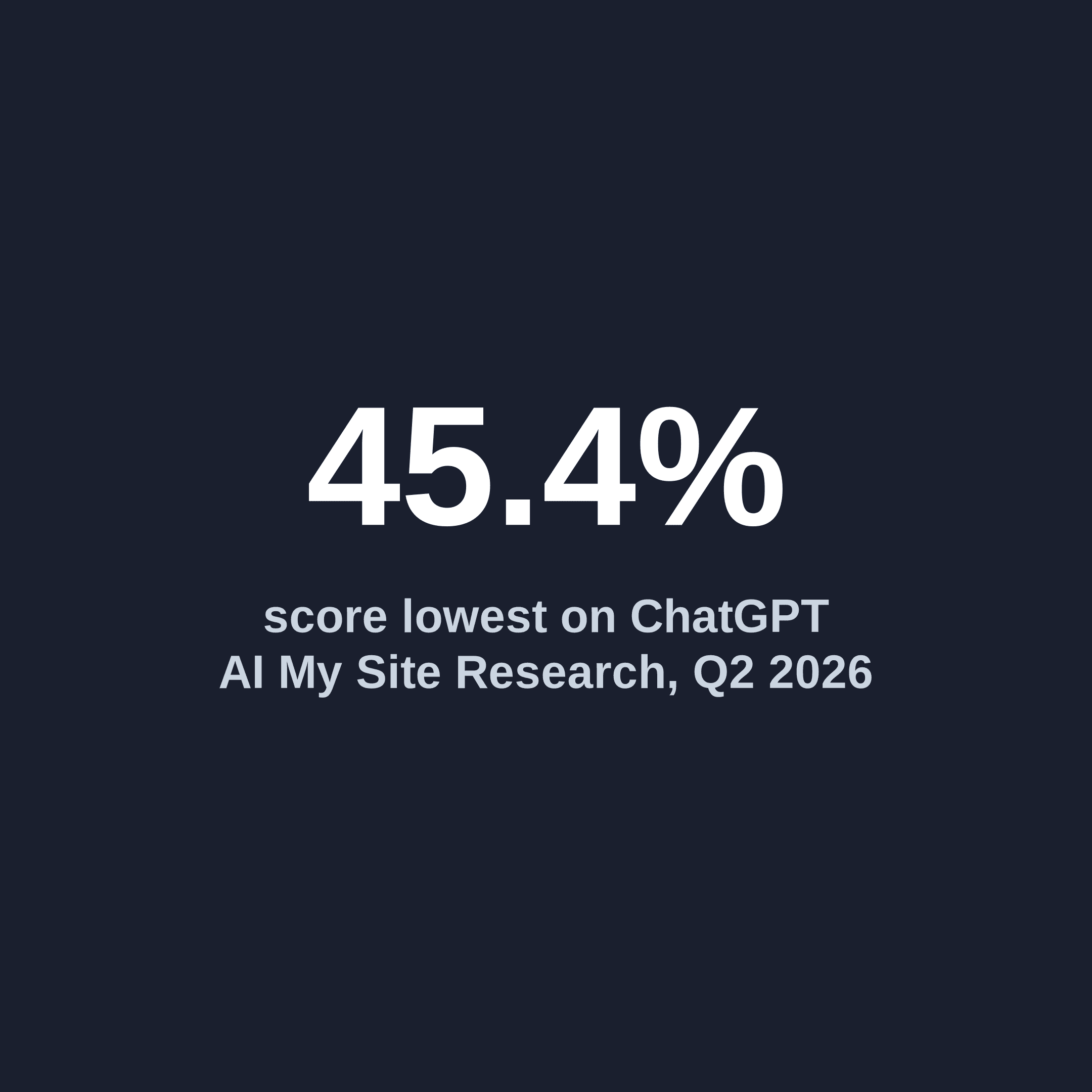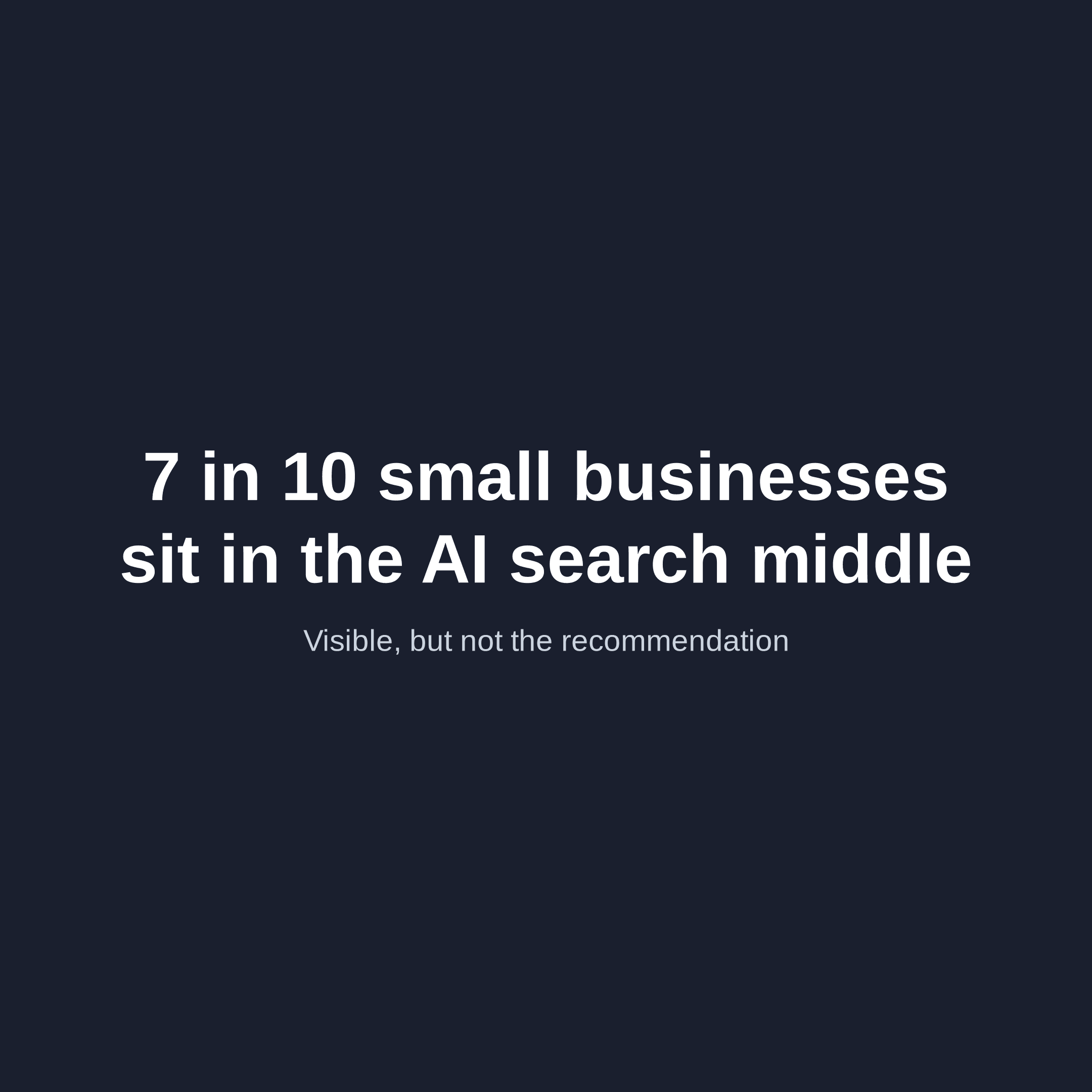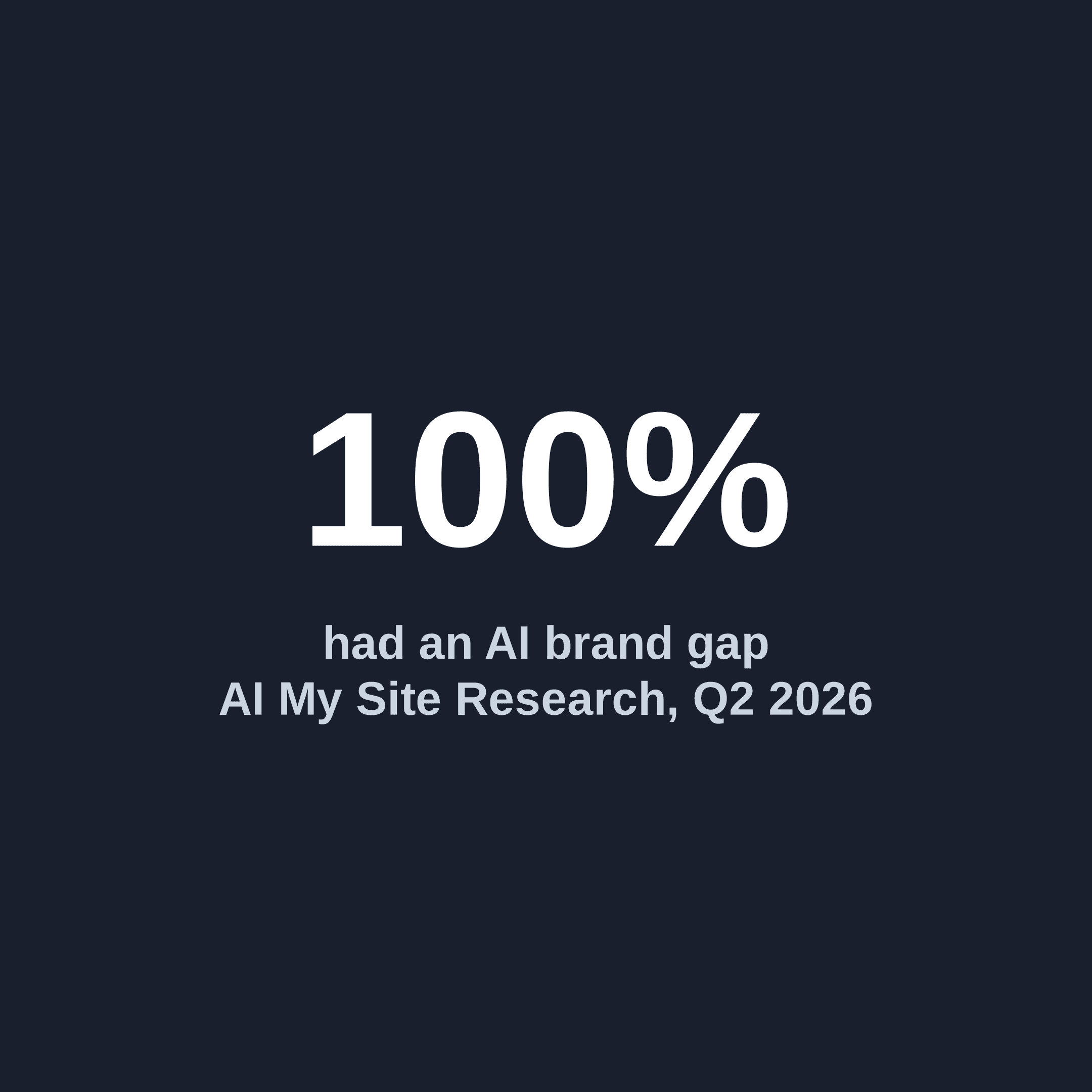
Every one of the 500 small businesses scanned had at least one open gap in how AI assistants describe their brand. Not most of them. Not only the ones with weak websites. All 500, across six industries and six countries, on every platform examined. It is the one finding in the Q2 2026 benchmark that came back the same for everybody.
That sounds alarming, so it is worth being precise about what it means. It does not mean every brand is broken. It means no business scanned was already perfect in how AI describes it, and each one had at least one specific thing worth improving. Here is what an AI brand gap actually is, why standard SEO tools never show it, and what closes it.
What an AI brand gap actually looks like
An AI brand gap is the distance between how you would describe your business and how an AI assistant describes it when a potential customer asks. This was measured by prompting ChatGPT, Claude and Gemini about each business with no priming, the way a real buyer would, and reading back what they said.
The gaps fall into a few familiar shapes. An assistant confuses you with a competitor that has a similar name. It describes what you do in vague or generic terms that could apply to any business in your category. It misses the one thing that actually sets you apart, the specialism or the location or the type of client you serve best. Or it mentions you, but weakly, the kind of passing reference that does not turn into a recommendation. A garden design studio in Bristol might be described simply as a landscaping company, with nothing about the award-winning small-garden work that is the whole point. A software firm might be folded in with three larger competitors and never named as the specialist option.
None of these are catastrophic on their own. Together they are the difference between being mentioned and being chosen.
Why standard SEO tools miss this layer
If your usual SEO audit comes back clean, it is reasonable to assume AI search is handled too. It is not. The traditional toolchain was built for an older job: checking whether a page can be indexed and ranked by signals like backlinks, page speed and keyword coverage. That work still matters, and most small businesses do it reasonably well. In the sample the average technical health score was 84 out of 100.
But an AI assistant does something different. It does not just rank your page. It reads across the web and synthesises an answer about your business in its own words. Whether that answer is accurate, specific and positive depends on signals a page-ranking audit was never designed to look at. The only way to see an AI brand gap is to scan how the assistants actually talk about your brand, with no priming, and compare it to the truth. That is a different kind of check, and it is the layer the mainstream tools do not cover.
Why every business has at least one, and why that is good news
It would be easy to read 100% as a verdict. It is closer to the opposite. The AI-brand layer was the only part of the scan where every single business had something open, while the heaviest-need AI-visibility escalation appeared for just 5.2% of sites. In other words, almost nobody is in crisis, and almost everybody has a clear, specific improvement available.
Even the top performers in the sample, the businesses scoring 88 out of 100 overall, had at least one AI-brand item worth addressing. So the universal finding is not that small businesses are failing. It is that the AI-brand layer is new, and nobody has finished it yet, because most owners have never been shown it. The businesses that act on it first have the field largely to themselves.
This is the layer AI My Site was built to surface. It scans how each assistant describes your business, shows you the specific gaps in plain language, and hands you a prioritised list of what to change on your site so the next answer is better. The action plan, not just the audit.
Common mistakes to avoid
-
Assuming invisibility is the problem. Most businesses are mentioned by AI already. The gap is usually in how they are described, not whether they appear at all.
-
Trusting a clean SEO audit. Technical health and AI brand description are separate layers. A strong SEO score tells you nothing about how an assistant talks about you.
-
Reading 100% as a failing grade. It reflects having at least one open item, not a broken brand. Treat it as a list to work through, not a verdict.
-
Fixing the website copy without checking the source. Rewriting your About page does not help if you never read back what the assistants actually say. Diagnose first, then change the pages that move the answer.
How long does this take
Most of the changes that improve how AI describes you are an afternoon's work to draft and a few hours over the following weeks to apply and check. In practice, businesses that work through a prioritised list tend to see movement over a 4 to 12 week window, depending on how much they apply and how competitive their category is. This is not an overnight switch, and anyone promising a guaranteed result is guessing. What the data supports is simpler: every business has at least one AI-brand gap, the gaps are specific, and they are closeable with focused work.
Frequently asked questions
What exactly is an AI brand gap?
It is a specific, fixable issue in how an AI assistant describes your business when a customer asks, such as confusing you with a competitor, describing you in generic terms, or missing what makes you different. It is defined as having at least one open recommendation in the AI-brand part of the scan.
Does 100% mean every business is doing badly?
No. It means no business scanned was already perfect across every AI-brand dimension, so each had at least one thing worth improving. Only 5.2% of sites surfaced the heaviest-need AI-visibility escalation. The universal finding is an opportunity, not a failing grade.
Why do my existing SEO tools not show this?
They were built to check whether a page can be indexed and ranked, not to read how an AI assistant synthesises an answer about your brand. Seeing an AI brand gap means scanning the assistants directly with no priming, which is a different check.
How did you measure this?
500 small and medium businesses across ChatGPT, Claude and Gemini in six countries and six industries during Q2 2026 were scanned, prompting each assistant about every business the way a real customer would and recording the gaps.
See where you sit
If every business has at least one AI-brand gap, the useful question is which one is yours. The full Q2 2026 State of AI Search benchmark has been published, with the breakdown by scan area, industry, country and platform, so you can see where your category sits and what a strong AI description looks like for a business like yours.
Read the full Q2 2026 benchmark to see the data for yourself.
AI My Site Research · Q2 2026 · n=500. AI search visibility, not revenue or conversion, was measured. Figures are a Q2 2026 point-in-time snapshot.
See how your own site scores
AI My Site checks all of this automatically and gives you a prioritised, plain-English plan for what to fix first.
Get your scores — £60/month →