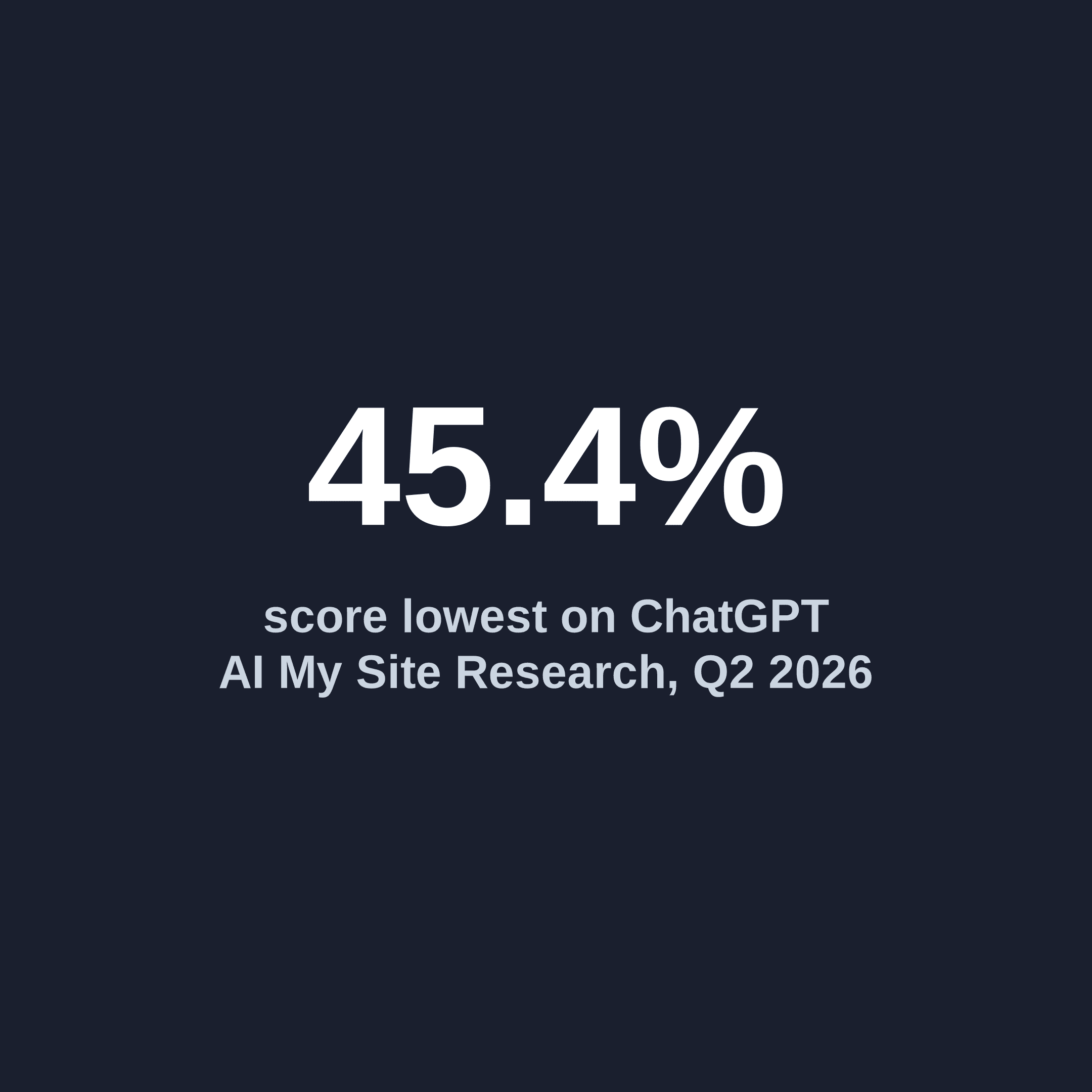
ChatGPT is the lowest-scoring AI assistant for 45.4% of the small businesses we scanned, a bigger share than any other assistant. When we benchmarked 500 small and medium businesses across ChatGPT, Claude and Gemini, the typical business had a 10-point spread between its best and worst-performing assistant, and the assistant most likely to be the weak link was ChatGPT. Because ChatGPT has by far the largest user base, that is the gap that tends to cost the most.
If you have been treating AI search as one thing to optimise for, this is the finding worth sitting with. Here is what the per-assistant data shows, why the same site scores so differently across models, and what closes the gap.
Not all AI assistants see your site the same way
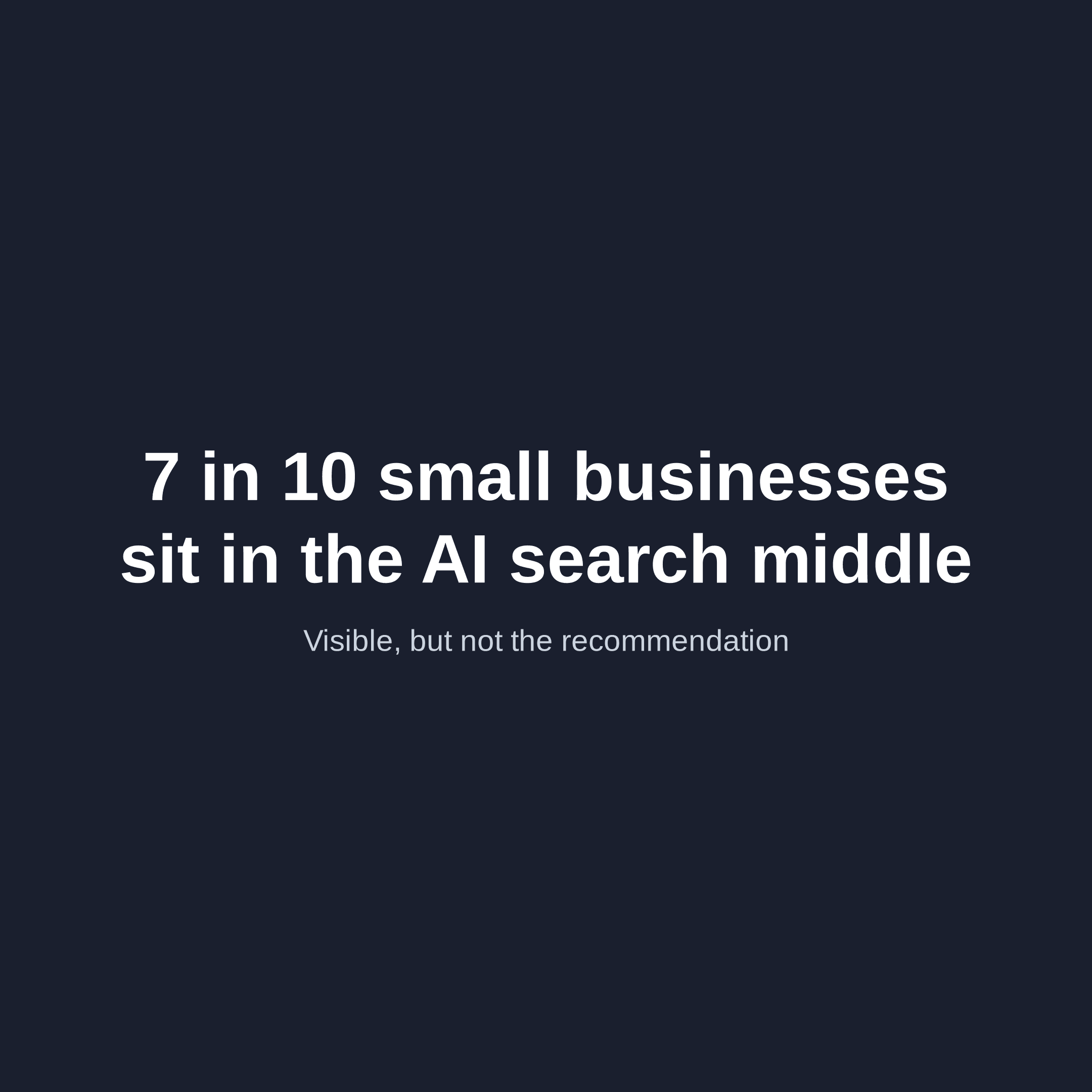
The instinct is to think of AI search as a single channel. The data says otherwise. Across our 500-business sample, the average gap between a business's best and worst-performing assistant was 10.7 points. Half of the businesses we scanned (50.2%) had a spread of 10 points or more. More than one in five (22.2%) had a spread of 15 points or more, and 8.4% had a spread of 20 points or more, visible on one assistant and almost absent on another.
So the same business can be a confident recommendation on one assistant and an afterthought on another, scanned on the same day. A dental practice in Cardiff might come up readily on Gemini and barely register on ChatGPT. A B2B software firm in Leeds might see the reverse. The spread is real, and it means optimising for AI search in the abstract leaves gaps you cannot see.
Why ChatGPT is the most common weak link
When we looked at which assistant scored lowest for each business, the pattern was clear. ChatGPT was the weak link for 45.4% of the businesses we scanned. Claude was the weak link for 41.4%. Gemini was lowest for just 5.6%, and 7.6% tied across two or more assistants.
The reason is not that ChatGPT is harder to please in some arbitrary way. It is stricter about grounding. It wants clearer evidence before it will name a business in a recommendation: category language that states plainly what you do, structured content that answers the questions a buyer actually asks, and positioning that is easy to synthesise into a single sentence. Gemini is more willing to mention businesses with thinner public signals, which is why it is rarely the weak link. ChatGPT asks for more, and most small businesses have not given it what it asks for.
This is not a content-volume problem. Adding more pages does not fix it. It is a specificity problem, and the fixes are particular rather than vague.
Closing the gap without optimising three times over
Here is the part that makes this manageable. The fixes that lift the strictest assistant are largely the same fixes that lift the others, applied with more care. Clearer page titles and descriptions, structured data that tells an assistant exactly what kind of business you are, and content that answers real customer questions in plain language all push in the same direction. You are not running three separate optimisation projects. You are doing one set of well-chosen fixes that happens to lift your weakest assistant the most.
This is where AI My Site fits. It reports your score per assistant, so you can see whether ChatGPT, Claude or Gemini is holding you back, then gives you a single prioritised plan designed to raise visibility across all three from one set of changes. The action plan, not just the audit.
Common mistakes to avoid
-
Treating AI search as one channel. ChatGPT, Claude and Gemini weight different signals. A business can be strong on one and weak on another, so a single AI score hides where the real gap is.
-
Assuming more content fixes a low assistant. The weak link is usually a specificity problem, not a volume problem. Clearer positioning beats more pages.
-
Optimising for the assistant you personally use. Your customers may be using a different one. Check where you are weakest before deciding what to fix.
-
Running three separate projects. The fixes overlap heavily. One well-ordered list lifts all three assistants, so there is no need to optimise three times over.
How long does this take
Most of the high-impact changes are an afternoon's work to draft and a few hours over the following weeks to apply and check. In practice, businesses that act on a prioritised list tend to see movement over a 4 to 12 week window, depending on how much they apply and how competitive their category is. This is not an overnight switch, and anyone promising a guaranteed score is guessing. What the data supports is simpler: the per-assistant gap is real, it is measured, and it is closeable with focused work.
Frequently asked questions
Which AI assistant should I worry about most?
For the largest share of businesses in our sample it was ChatGPT, the weak link for 45.4% of the 500 we scanned. But 41.4% were weakest on Claude, so the honest answer is to check your own per-assistant scores rather than assume.
Why does the same site score so differently across assistants?
The assistants weight different signals. ChatGPT and Claude are stricter about grounding and want clearer evidence before recommending a business. Gemini is more willing to mention businesses with thinner signals. The average gap between a business's best and worst assistant in our sample was 10.7 points.
Do I need to optimise separately for each assistant?
No. The fixes overlap heavily. A single prioritised list of changes, applied carefully, tends to lift all three assistants at once. The diagnosis differs per assistant; the work mostly does not.
Which assistants did you measure?
ChatGPT, Claude and Gemini, scanned across 500 small and medium businesses in six countries and six industries during Q2 2026.
See where you sit
Knowing which assistant is your weak link is the difference between scattered effort and a focused plan. We have published the full Q2 2026 State of AI Search benchmark, with the per-assistant breakdown and splits by industry, country and platform, so you can see where your category sits and what good looks like for a business like yours.
Read the full Q2 2026 benchmark to see the data for yourself.
AI My Site Research · Q2 2026 · n=500. We measured AI search visibility, not revenue or conversion. Figures are a Q2 2026 point-in-time snapshot.
See how your own site scores
AI My Site checks all of this automatically and gives you a prioritised, plain-English plan for what to fix first.
Get your scores — £60/month →