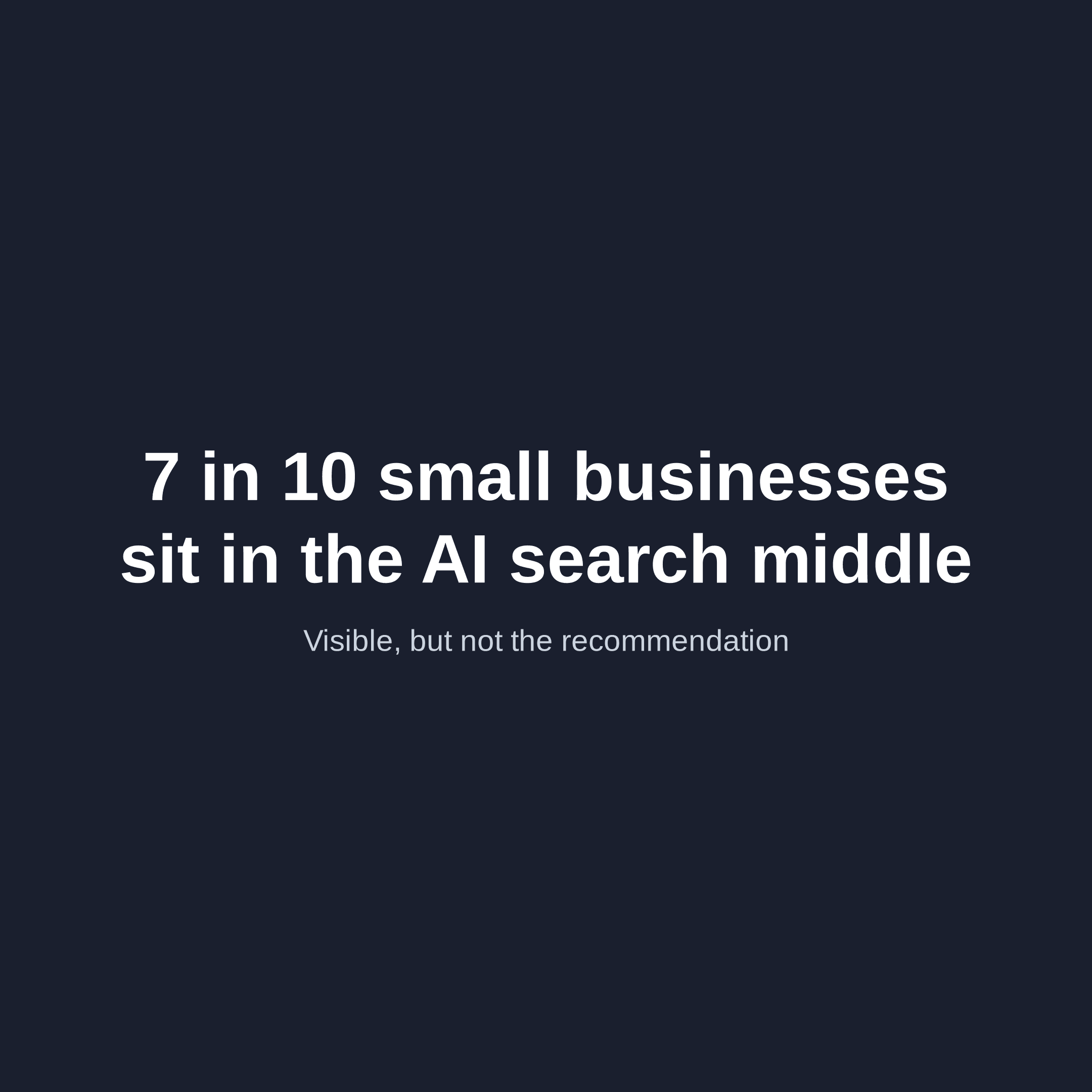
Most small businesses are not invisible to AI assistants. They are simply not the recommendation. When we scanned 500 small and medium businesses across ChatGPT, Claude and Gemini, 95 in 100 were visible enough to be mentioned, but only 26 in 100 scored at the level where AI puts them first. The gap between being mentioned and being recommended is where most small businesses quietly lose customers.
If you run a small business and you have wondered whether AI search is a problem for you, this is the finding that matters. Here is what the data shows, why the middle of the pack is so crowded, and what closes the gap.
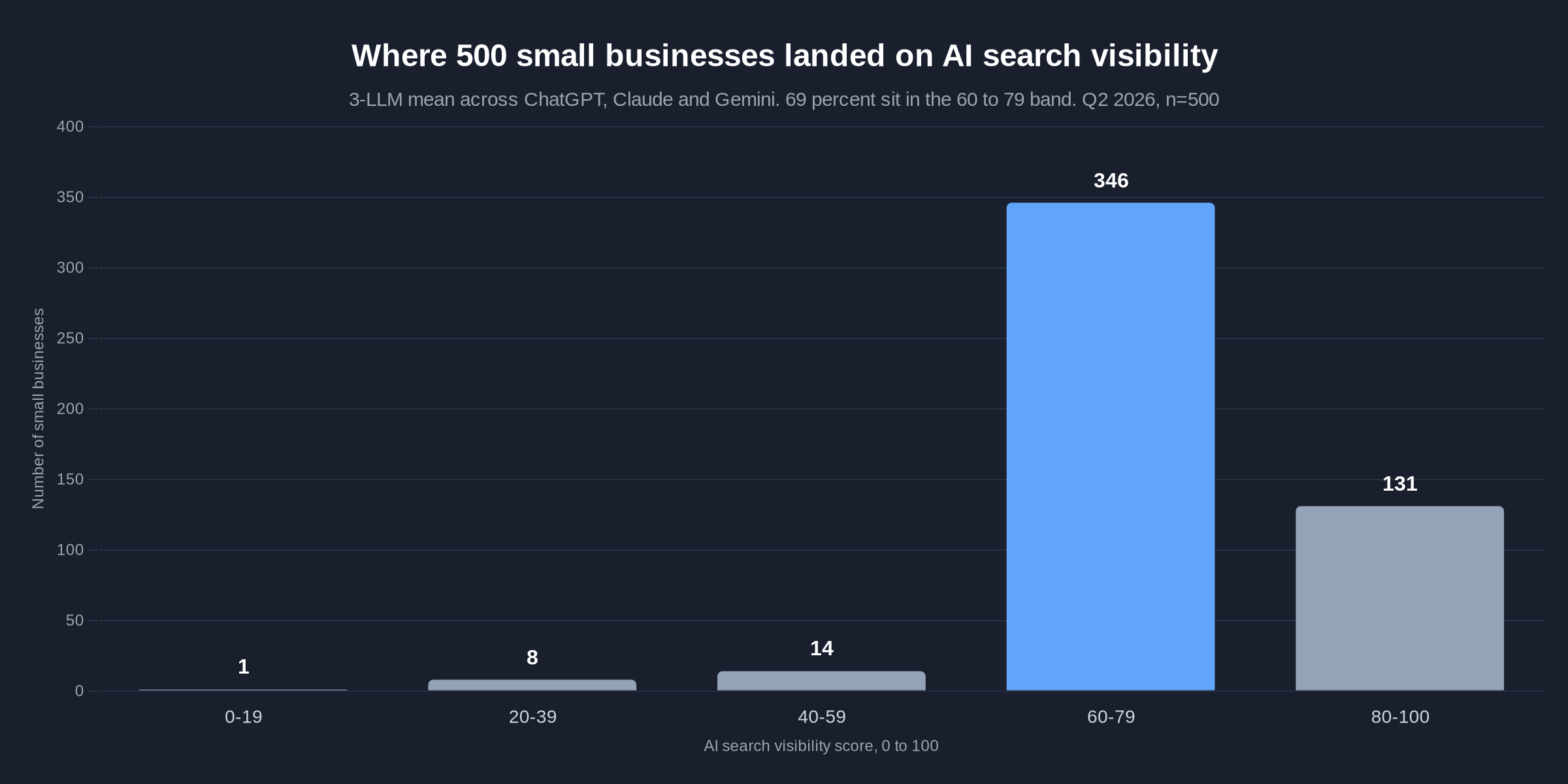
The problem isn't visibility. It's the crowd in the middle.
The picture people expect is one of invisibility, a small business that AI has never heard of. The data tells a different story. Across our 500-business sample, only 4.6% scored below 60 out of 100 on AI search visibility. Almost everyone is in the conversation.
The trouble is where they sit in it. Nearly seven in ten businesses (69.2%) are clustered in the 60 to 79 "Good" band. We call this the Massive Middle. These businesses appear when a customer asks an AI assistant for a recommendation in their category. They just appear alongside two or three others, never first and never alone. The customer takes the first clear name, and the business with slightly sharper positioning gets the click.
Only 26.2% reach the 80-plus "Excellent" band, where AI recommends a business consistently rather than occasionally.
Why so many businesses land in the middle
The reasons are rarely dramatic. A florist in York might have a lovely site that loads quickly and reads well to a human, but no structured information telling an AI what it sells, where, and to whom. An accountancy firm in Nottingham might rank fine on Google yet describe itself in the same vague terms as every other firm, so AI cannot tell it apart. A boutique hotel in Bath might have glowing reviews scattered across platforms that never make it onto its own pages.
None of these are failures. They are gaps, and they are the same handful of gaps repeating across industries. This is the gap AI My Site was built to close: it scans how ChatGPT, Claude and Gemini actually describe a business with no prompting, then returns a short, prioritised list of the changes that lift it out of the middle, ranked by impact.
What moves a business from mentioned to recommended
The encouraging part is how small the distance is. The average business in our sample scored 73 out of 100. The top performers in each industry scored around 88. That is a gap of roughly 15 points, not 50, and it is made up of specific, fixable items rather than a rebuild.
On average, each business had about nine high-priority issues open at the time of the scan. That sounds like a lot until you realise they are mostly the same well-understood fixes: clearer page titles and descriptions, structured data that tells AI what kind of business you are, and positioning that states plainly what you do and who you serve. The reason most businesses stay in the middle is not lack of effort. It is that nobody has told them which three things to fix first, so the work scatters.
Fix in order of impact, and the score moves. That is the whole idea.
Common mistakes to avoid
-
Assuming good SEO means good AI visibility. They are related but separate. A site can pass its Google checks and still be hard for an AI assistant to summarise into a recommendation.
-
Trying to fix everything at once. A long, unranked list of problems leads to scattered effort. The businesses that improve fastest fix the highest-impact items first.
-
Writing for the algorithm instead of the question. AI assistants answer real customer questions. Pages that answer those questions plainly tend to get surfaced; pages stuffed with keywords do not.
-
Leaving your best proof off your own site. Reviews, credentials and specifics that live only on third-party platforms can't do much for you where it counts, on your own pages.
How long does this take
Most of the high-impact changes are an afternoon's work to draft and a few hours over the following weeks to apply and check. In practice, businesses that act on a prioritised list tend to see movement over a 4 to 12 week window, depending on how much they apply and how competitive their category is. This is not an overnight switch, and anyone promising a guaranteed score is guessing. What the data supports is simpler: the gap is real, it is measured, and it is closeable with focused work.
Frequently asked questions
Is my business invisible to AI search?
Probably not. In our sample, 95% of small businesses were visible enough to be mentioned by AI assistants. The more common issue is being mentioned without being recommended.
What's the difference between being mentioned and being recommended?
Being mentioned means an AI assistant knows you exist and may list you among others. Being recommended means it puts you first, or names you on its own, when a customer asks. The second is what drives enquiries.
How big is the gap I'd need to close?
For the typical business in our benchmark, about 15 points, from an average of 73 to the category-leading 88. That is a focused list of fixes rather than a site rebuild.
Which AI assistants did you measure?
ChatGPT, Claude and Gemini, scanned across 500 small and medium businesses in six countries and six industries during Q2 2026.
See where you sit
Being visible is not the same as being chosen, and the difference is a measured, closeable gap. We have published the full Q2 2026 State of AI Search benchmark, with breakdowns by industry, country and platform, so you can see where your category sits and what "good" looks like for a business like yours.
Read the full Q2 2026 benchmark to see the data for yourself.
AI My Site Research · Q2 2026 · n=500. We measured AI search visibility, not revenue or conversion. Figures are a Q2 2026 point-in-time snapshot.
See how your own site scores
AI My Site checks all of this automatically and gives you a prioritised, plain-English plan for what to fix first.
Get your scores — £60/month →