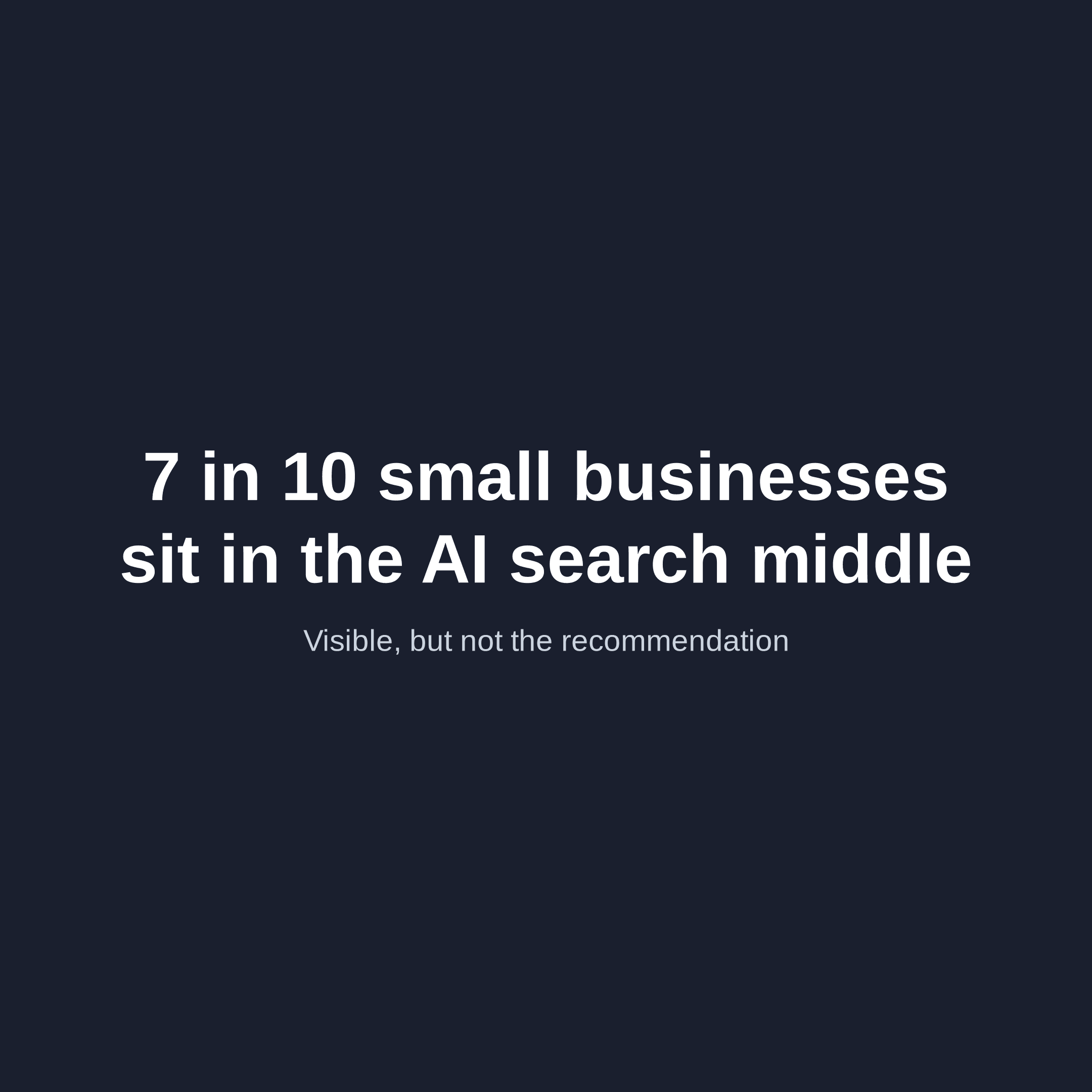
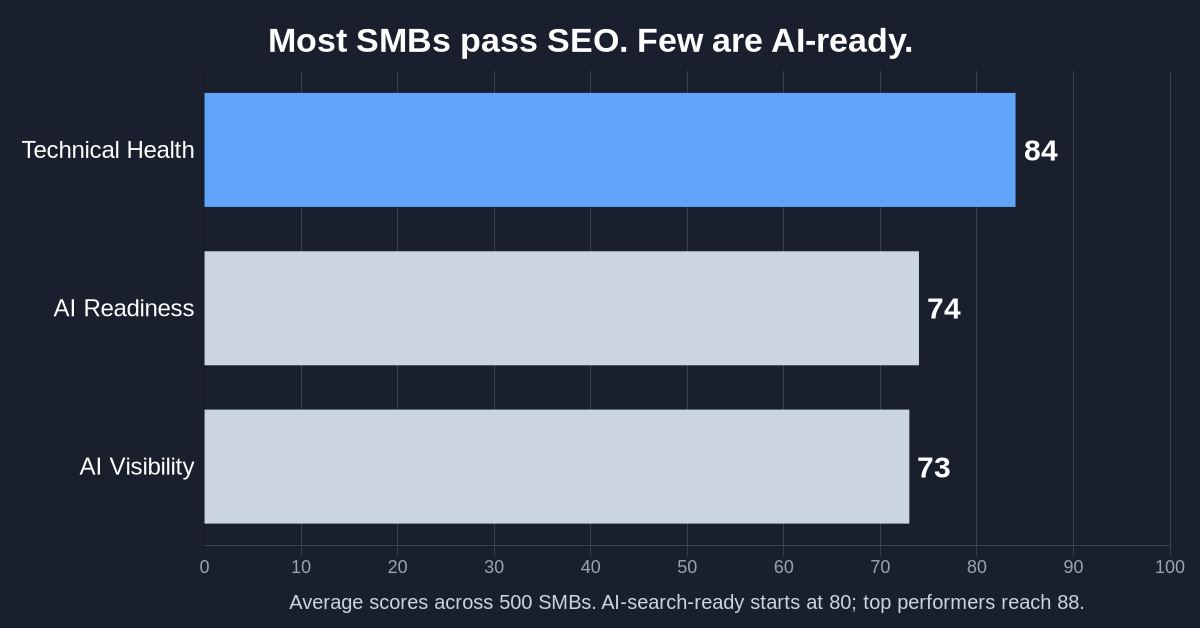
Most small businesses are already good at traditional SEO and still lose in AI search. When we scanned 500 small and medium businesses, the average site scored 84 out of 100 on technical health, the SEO basics, but only 74 on AI readiness and 73 on whether AI assistants actually mention it. The gap between that first number and the other two is the work, and it is the layer most tools never check.
If your site loads quickly and ranks fine on Google yet rarely comes up when someone asks ChatGPT or Gemini for a recommendation, this is why. Here is what the three scores mean and what moves the bottom two.
Three scores, not one
Most tools give you a single SEO number. The scan behind this benchmark gives three, because the work behind each is different. Technical health asks whether your site is fast, mobile-friendly and indexable. The average across the 500 businesses was 84 out of 100, a strong score. Most small businesses have this layer handled.
AI readiness asks something different: is your content structured so an AI assistant can understand and repeat it. The average was 74. AI visibility, whether ChatGPT, Claude and Gemini actually mention you when a customer asks about your category, came in at 73. Same sites, two more layers, and a clear step down from the SEO basics.
Why good SEO doesn't carry over
Traditional audit tools were built for Google's classic algorithm, where fast pages and backlinks win. They measure that first number well. AI assistants ask different questions and reward different things: content structured so it can be parsed, schema markup that states plainly what kind of business you are, and positioning a machine can turn into a recommendation.
A driving instructor in Cardiff might have a quick, tidy site that says nothing an AI can use to tell it apart from the next instructor. An ecommerce shop in Leeds might rank well for its product names yet bury what it sells inside images an assistant cannot read. This is the layer AI My Site was built to add: it scans how ChatGPT, Claude and Gemini read your site and gives you the action plan, not just the audit.
What closes the gap
The encouraging part is how small the distance is. The average AI visibility score was 73 and the best performers reached 88, a gap of about 15 points rather than 50. It is made of specific, repeatable fixes. Two in three of the businesses we scanned, 66 percent, were missing structured data, the highest-impact technical fix after the basics. And 94 percent had a weak or missing meta description, the short line that tells an assistant what a page is about.
Add clear positioning that states what you do and who you serve, work through it in order of impact, and the bottom two scores start to move. None of it is a redesign.
Common mistakes to avoid
-
Assuming a good Google ranking means AI can see you. Technical health and AI visibility are separate layers with separate work.
-
Treating AI readiness as more SEO. It needs structured data and clearer positioning, not more keywords.
-
Fixing everything at once. An unranked list scatters effort; the businesses that improve fastest fix the highest-impact items first.
-
Skipping the basics. Page titles and meta descriptions are quick wins most sites still leave undone.
How long does this take
Drafting the high-impact fixes is usually an afternoon's work, then a few hours over the following weeks to apply and check. Businesses that act on a prioritised list tend to see movement over a 4 to 12 week window, depending on how much they apply and how competitive their category is. There is no overnight switch, and anyone promising a guaranteed score is guessing. What the data supports is simpler: the gap between the SEO layer and the AI layer is real, measured and closeable.
Frequently asked questions
What's the difference between Technical Health, AI Readiness and AI Visibility?
Three separate measurements. Technical Health is the SEO basics, whether your site is fast, mobile-friendly and indexable, averaging 84 across our sample. AI Readiness is whether your content is structured for AI to understand, averaging 74. AI Visibility is whether AI assistants actually mention and recommend you, averaging 73.
If my SEO is good, isn't my AI search good too?
Not necessarily. The average business in our benchmark scored 84 on technical health but 73 on AI visibility. Same site, a different layer of work, a lower score.
How big is the gap I'd need to close?
For the typical business, about 15 points, from an average of 73 to a category-leading 88. That is a focused list of fixes rather than a site rebuild.
What's the single highest-impact fix?
After your page titles and meta descriptions, structured data, also called schema markup, which tells an assistant exactly what kind of business you are. Two in three of the businesses we scanned were missing it.
See where you sit
Passing your SEO checks is not the same as being recommended by AI, and the difference is a measured, closeable gap. We have published the full Q2 2026 State of AI Search benchmark, with the three scores broken down by industry, country and platform, so you can see where your category sits.
Read the full Q2 2026 benchmark to see the data for yourself.
AI My Site Research · Q2 2026 · n=500. We measured AI search visibility, not revenue or conversion. Figures are a Q2 2026 point-in-time snapshot.
See how your own site scores
AI My Site checks all of this automatically and gives you a prioritised, plain-English plan for what to fix first.
Get your scores — £60/month →