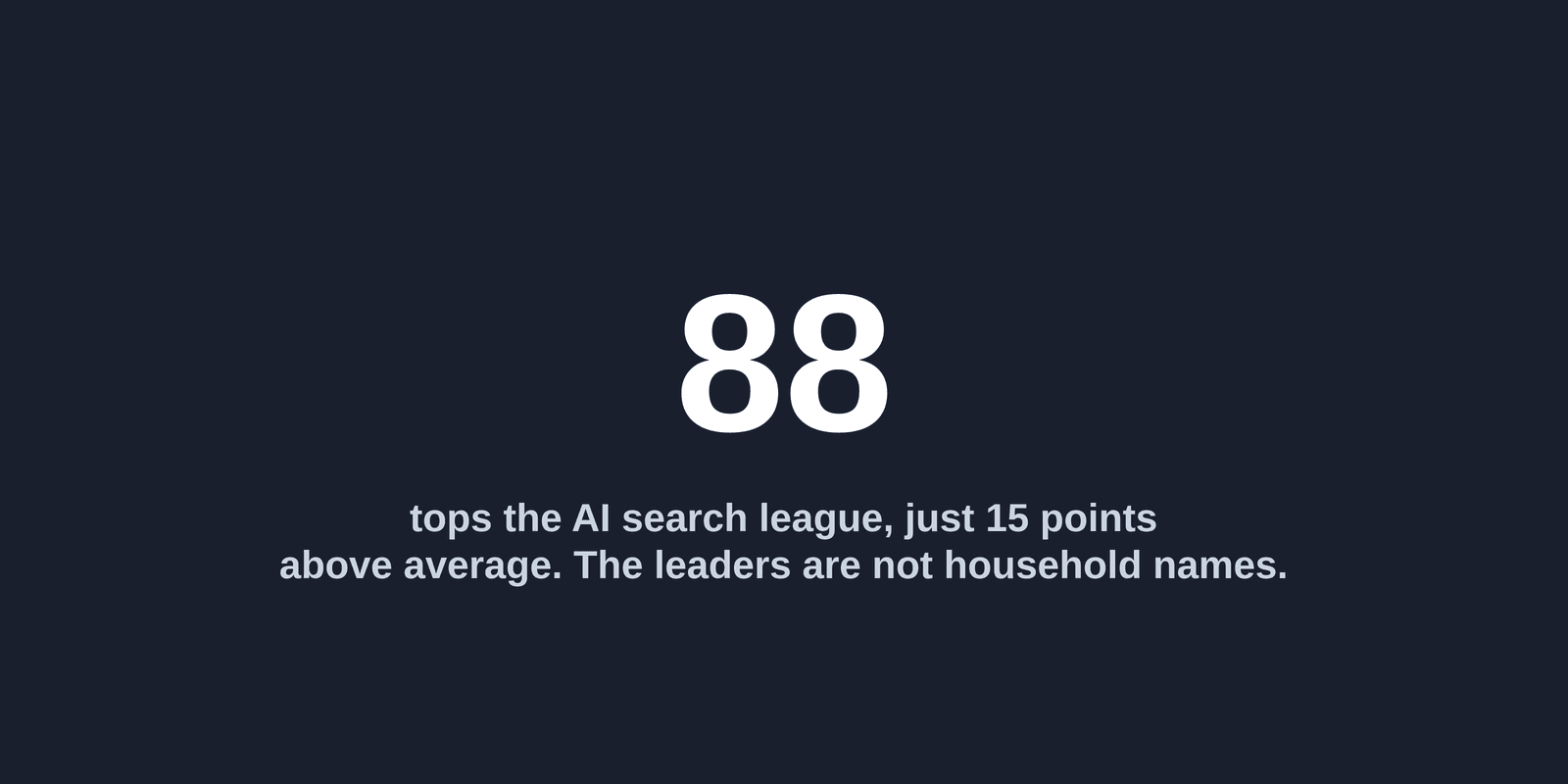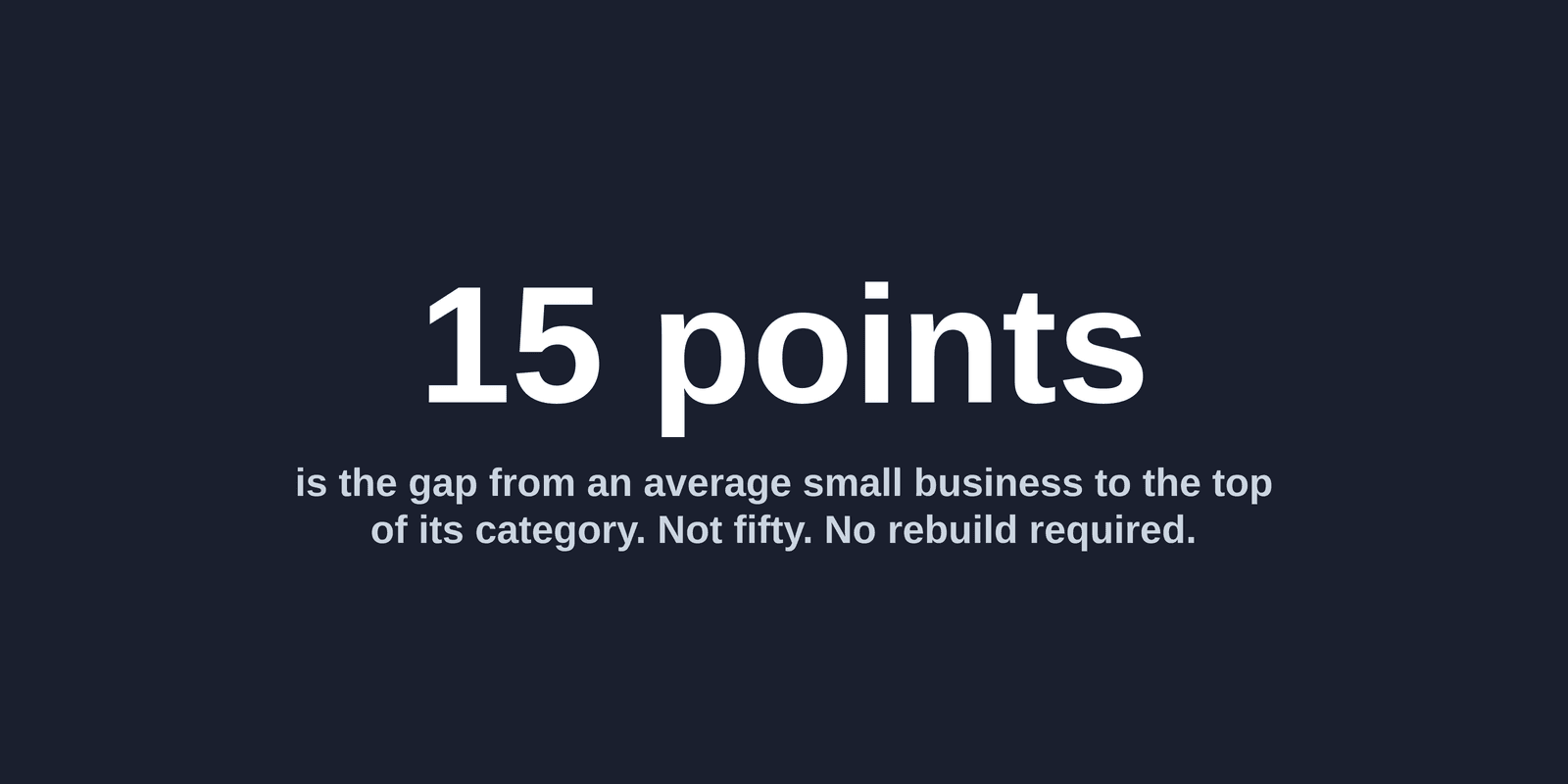
The gap between an average small business and the top of its category on AI search is fifteen points, not fifty. Across our 500-business benchmark the typical site scored 73 out of 100 and the top of the table sat at 88, and closing that distance is a focused list of fixes rather than a rebuild.
This post explains why the work is smaller than most owners fear, what the fifteen-point gap is actually made of, and how to close it without redesigning your site or hiring an agency.
The gap is fifteen points, not fifty
The biggest blocker for most small business owners is not the work. It is the assumption that the work is enormous, that being ready for AI search means tearing the site down and starting again. The data says otherwise. In our Q2 2026 benchmark the average small business scored 73 out of 100 on AI search visibility, and the best-performing site in the sample reached 88. That is a fifteen-point gap between a typical business and the top of its category.
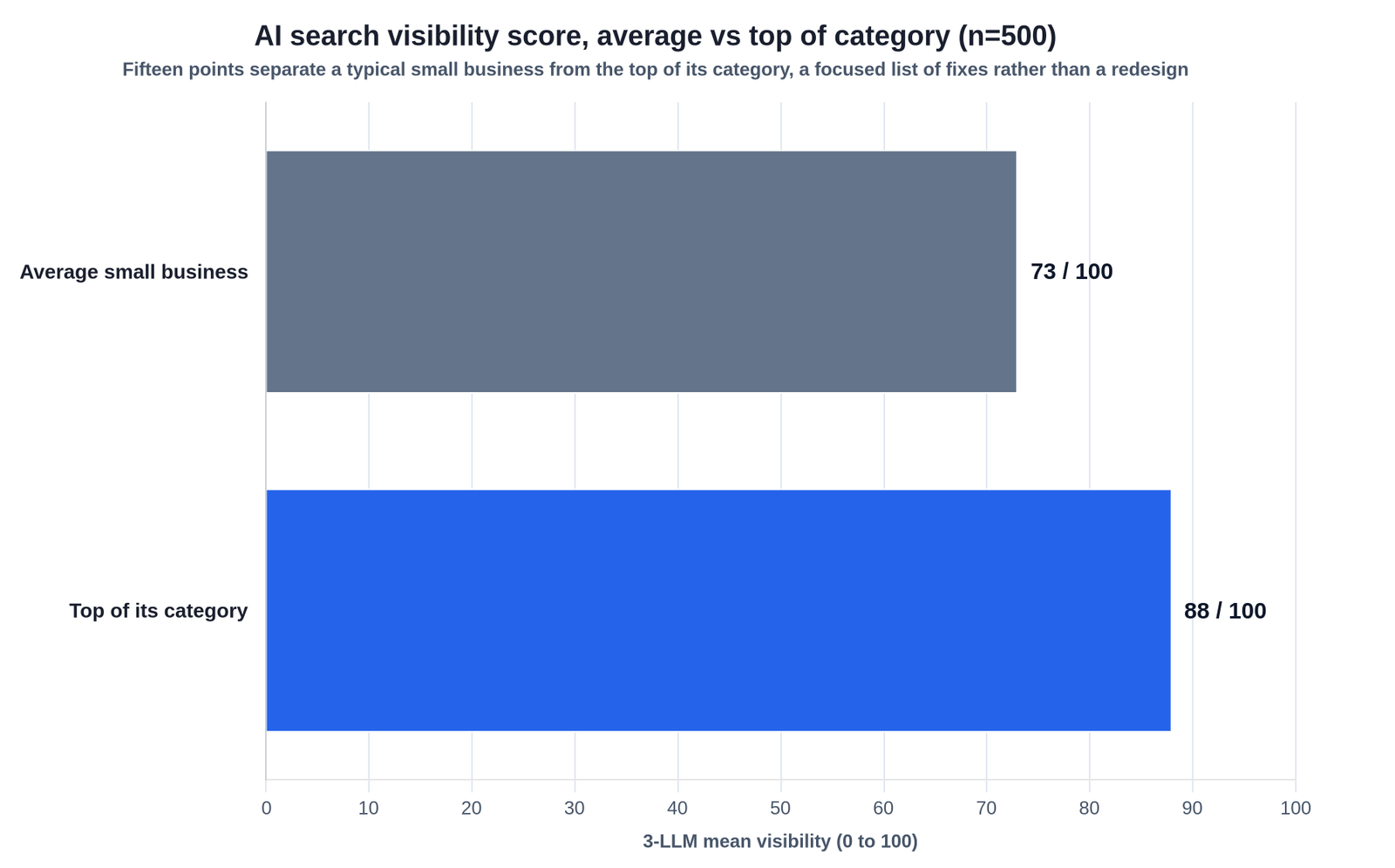
Fifteen points is a meaningful distance, but it is a closeable one. The scores in our sample clustered tightly, within about ten points of the average either way, so most businesses are nearer the middle than the extremes. Moving up the table is a question of finding the right handful of changes, not reinventing the whole site.
What the gap is actually made of
When we counted the issues holding sites back, the average business carried around nine high-priority items. Not one enormous problem, and not a hundred small ones, but a short, specific list. The most common entries are familiar and undramatic: a missing or generic meta description, a title tag that does not say what the business is, absent schema markup, a page that loads slowly, and a few brand-description gaps in how AI assistants talk about the business.
None of these need a designer. None need new page templates or a fresh copy deck written from scratch. They are edits to things that already exist on the site, the kind of work an owner or a single member of the team can do in sequence. The reason the gap persists is not effort, it is that nobody hands most owners the list in priority order, so good work scatters across the wrong things.
How to close it without a rebuild
Start with the fixes that touch the most pages for the least effort. The meta description and title tags come first, because they are the most widespread issue in our data and take minutes each. Schema markup is the next win, the structured code that tells an AI assistant what kind of business you are. After that come the technical items, such as page speed, and the brand-description gaps that shape how an assistant summarises you. Work down the list in order, check each change, and move on.
This is where AI My Site fits. It scans your site, ranks every relevant issue by its impact on AI search visibility, and gives you the top items first with the recommended replacement value for each, plus step-by-step guides for platforms like WordPress, Shopify and Squarespace. You fix in sequence, no diagnosis and no guesswork. The action plan, not just the audit.
Common mistakes to avoid
- Assuming AI search means a rebuild. The gap from average to the top of a category is about fifteen points, and it closes with edits to what already exists, not a new site.
- Trying to fix everything at once. The typical site has around nine high-priority items. Work the top three first, then the next three, rather than spreading effort thin.
- Starting with the hardest item. Lead with the widespread, low-effort fixes like meta tags and schema before the more involved technical work, so you bank early progress.
- Waiting for a big project window. The list does not need an agency or a quarter of runway. It is a sequence of small changes you can begin this week and apply over the following weeks.
How long does this take
The first pass on a small site is usually an afternoon of work rather than a project, followed by a few hours over the following weeks to apply and check the rest. Anyone promising an instant jump in AI answers is guessing. In practice, businesses that clear a prioritised list tend to see movement over a 4 to 12 week window, depending on how many issues they carry and how consistently they apply the changes. What the data supports is simpler: the gap is about fifteen points, the work is roughly nine focused fixes, and none of it requires a redesign.
Frequently asked questions
Do I need to rebuild my website for AI search?
No. In our Q2 2026 benchmark the gap between an average small business and the top of its category was about fifteen points, and it closes with edits to existing pages rather than a new site. The typical business had around nine high-priority fixes to make.
How big is the gap between an average business and the best?
The average small business scored 73 out of 100 on the 3-LLM mean and the top-performing site reached 88, a gap of fifteen points. The distribution was tight, so most businesses sit within about ten points of the average.
How many fixes am I likely to need?
The average site in our sample carried about nine high-priority issues, with a median of nine. They tend to be familiar items such as meta tags, schema markup, page speed and brand-description gaps, worked in priority order rather than all at once.
Where should I start?
Begin with the most widespread, lowest-effort fixes, the meta description and title tags, then schema markup, then the technical items. Clearing the top few first banks the quickest wins before you reach the more involved work.
See where you sit
If the gap to the top of your category is fifteen points rather than fifty, the useful question is where your business sits today and which fixes would move it. We have published the full Q2 2026 State of AI Search benchmark, with the score distribution, the issue prevalence and the breakdown by industry, country and platform, so you can see how you compare.
Read the full Q2 2026 benchmark to see where you sit.
AI My Site Research · Q2 2026 · n=500. The mean 3-LLM visibility score was 73.4 and the best site scored 87.7, a gap of about fifteen points; the average site carried 9.2 high-priority issues (median 9). We measured AI search visibility, not revenue or conversion. Figures are a Q2 2026 point-in-time snapshot.
Rather someone did this for you?
With One Site we rebuild your website and run it for you: a review every fortnight, technical fixes done ourselves, and the content changes you approve.
See One Site — £60 a month →