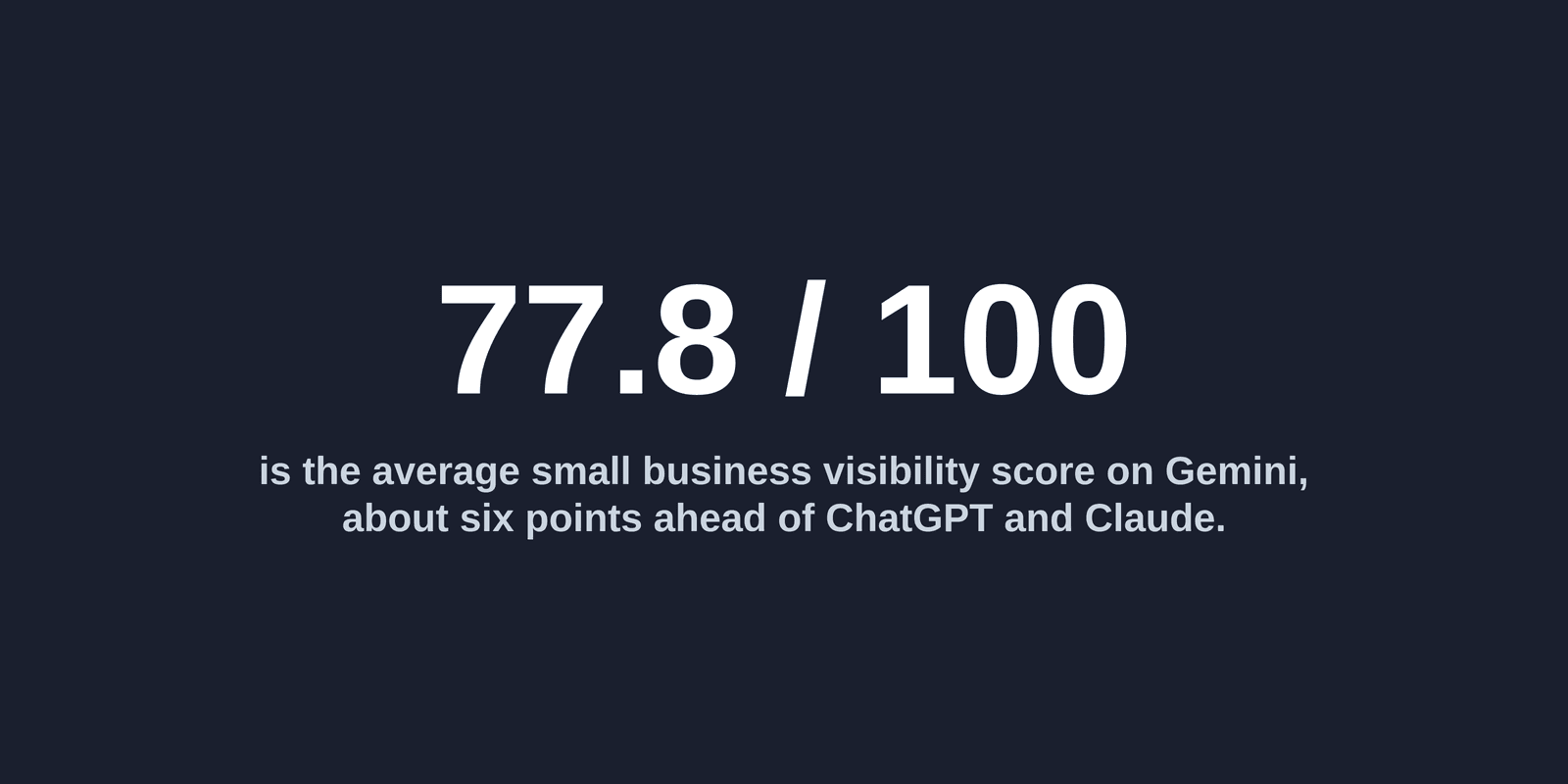
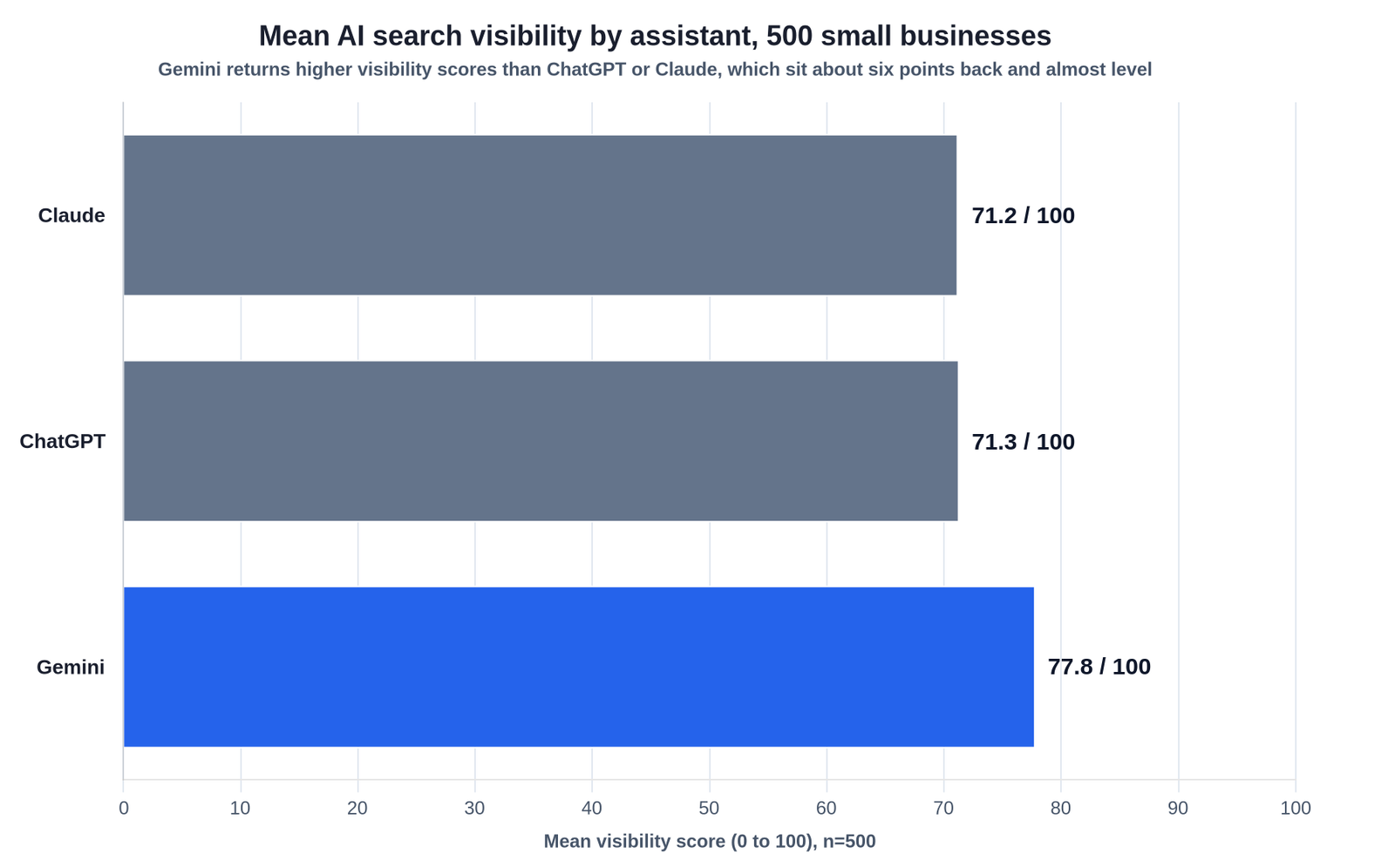
Gemini gives small businesses an average AI search visibility score of 77.8 out of 100, against 71.3 for ChatGPT and 71.2 for Claude, so the same business tends to score about six points higher on Gemini than on either of the other two. That is a finding about the assistants, not about your site.
This post explains why one assistant sees small businesses more easily than the others, what a good Gemini score does and does not tell you, and how to use the difference as a diagnostic, based on the Q2 2026 State of AI Search benchmark of 500 small and medium businesses.
Gemini sits about six points ahead of ChatGPT and Claude
We scored all 500 businesses on each of three assistants separately. Gemini averaged 77.8 out of 100. ChatGPT averaged 71.3 and Claude 71.2, which is close enough to call level. Those are sample-wide means, so the six-point difference describes the typical case rather than any one business.
One more figure makes the point sharper. When we look at which assistant scores lowest for each individual business, Gemini is the weakest of the three for only 5.6 percent of the businesses we scanned. For almost everyone else, Gemini is not the problem.
Why the other two hold back
This is our reading of the data rather than something the assistants publish about themselves. Gemini appears more willing to name a smaller business on thinner public evidence. ChatGPT and Claude are stricter about grounding: they want more corroboration before they put a name in an answer, so a business with a modest public footprint gets mentioned by Gemini and skipped by the other two.
Think of a physiotherapy clinic in Bristol with a clear website and a handful of reviews. Gemini has enough to work with and will offer the clinic when someone asks. ChatGPT and Claude see the same site, find less of the corroborating detail they look for, and answer with a category description or a larger chain instead. The clinic has not done anything wrong. It has simply cleared one bar and not the other two.
A good Gemini score is not a clean bill of health
The trap here is reading your best number as your real number. If you check one assistant, see a score in the high seventies and conclude AI search is handled, you have measured the assistant most likely to see you and stopped. Half of the businesses we scanned, 50.2 percent, had a spread of ten points or more between their best and worst assistant, so the single number you happen to check can sit well above the rest.
The direction of the mistake matters too. An independent bookshop in Norwich that scores well on Gemini and poorly elsewhere is not visible in most of the conversations its customers are having. The useful question is not whether any assistant can find you, but whether the ones your customers use can.
How to use the difference as a diagnostic
Two practical uses come out of this. The first is order of testing. Because Gemini sees small businesses most easily, it works as an early warning: if Gemini cannot describe what you do, the stricter two almost certainly cannot either, and the problem is on your site rather than in the assistant. Only 0.6 percent of the businesses we scanned drew a blank on Gemini, so that outcome is rare and worth treating as urgent.
The second is where the remaining lift sits. The distance between your Gemini score and the other two is a rough measure of how much corroboration your business is missing. Closing it is the same body of work either way: state plainly what you do and who you serve, mark the business up with structured data so its type and details are machine readable, answer the questions customers actually ask, and build the external mentions that let a cautious assistant check your claims. A small accountancy practice in Glasgow does not need different fixes for each assistant, it needs more of the evidence all three look for.
This is where AI My Site fits. It scans your site on each assistant, shows you the per-assistant scores side by side so the gap is visible, then ranks every relevant issue by its impact on AI visibility with the recommended value for each and step-by-step guides for your platform. You work down the list in order. The action plan, not just the audit.
Common mistakes to avoid
- Checking one assistant and calling it done. Half the businesses we scanned had a ten-point spread or more across assistants, so one score is not a reliable picture of the other two.
- Reading a high Gemini score as a better site. Gemini is the easier assistant to be seen by. The score reflects how readily it names smaller businesses as much as it reflects your site.
- Optimising for one assistant. The signals that win a mention are broadly the same across all three. Clear positioning, structured data and corroborating mentions lift every assistant at once.
- Ignoring a blank on Gemini. Drawing no mention on the assistant most willing to name small businesses is rare and points at something basic on your site rather than a quirk of the assistant.
- Treating the gap as permanent. The distance to the stricter assistants reflects corroboration you have not built yet, which is work rather than a fixed disadvantage.
How long does this take
Checking where you stand across the three assistants is same-day work. Acting on it is longer, because the gap to ChatGPT and Claude is partly built on evidence outside your own site. The on-site half, clearer positioning and structured data, is an afternoon plus a few hours of follow-up. The external half, reviews, listings and being written about, accrues over weeks. In practice, businesses that work through a prioritised list tend to see movement over a 4 to 12 week window, depending on how many issues they carry and how consistently they apply the changes. Anyone promising a specific jump in AI answers on a specific date is guessing. What the data supports is narrower: the assistants differ by about six points on average, and the gap reflects work the leading sites have done.
Frequently asked questions
Which AI assistant is easiest to be seen by?
Gemini, in our Q2 2026 benchmark. Across 500 small and medium businesses it averaged 77.8 out of 100 on AI search visibility against 71.3 for ChatGPT and 71.2 for Claude, and it was the lowest scoring of the three for only 5.6 percent of the businesses we scanned.
Does a high Gemini score mean my site is AI ready?
Not on its own. Gemini is the assistant most likely to name a smaller business, so it tends to be your highest score rather than your typical one. Half the businesses we scanned had a spread of ten points or more between their best and worst assistant.
Why do ChatGPT and Claude score lower?
Our reading is that both are stricter about grounding and want more corroboration before naming a business. That is analysis of our scan results rather than a published feature of either assistant. The two score almost identically, 71.3 and 71.2.
Should I optimise for Gemini specifically?
No. The fixes that lift visibility are broadly the same across the three: clear positioning, structured data, direct answers to customer questions and external mentions that corroborate what you say. The diagnosis differs by assistant, the work does not.
What if no assistant mentions my business?
It is uncommon. Only 0.6 percent of the businesses we scanned drew no mention on Gemini and 1 percent drew none on ChatGPT. When it happens it usually points at something basic, such as content an assistant cannot read or a site that never states plainly what the business does.
See where you sit
If the assistants differ by about six points on average, the useful question is what your own three scores look like and which of them your customers are actually using. We have published the full Q2 2026 State of AI Search benchmark, with the per-assistant means, the score distribution, the issue prevalence and the breakdown by industry, country and platform, so you can see how you compare.
Read the full Q2 2026 benchmark to see where you sit.
AI My Site Research · Q2 2026 · n=500. Mean AI search visibility by assistant: Gemini 77.8, ChatGPT 71.3, Claude 71.2. Gemini was the lowest scoring assistant for 5.6% of sites, and 50.2% of sites had a spread of ten points or more between their best and worst assistant. We measured AI search visibility, not revenue or conversion. Figures are a Q2 2026 point-in-time snapshot.
See how your own site scores
AI My Site checks all of this automatically and gives you a prioritised, plain-English plan for what to fix first.
Get your scores — £60/month →